
The periodic table can look a little chaotic at first, with its odd shape and its blocks of color. Every column has a reason behind it, though! Elements in the same group share a number of valence electrons, so they react in similar ways.
In this guide, we’ll walk through the specific chemical groups the MCAT tests, from the alkali metals to the noble gases and the transition metals. You’ll also see why melting and boiling points rise down some groups and fall down others. Let’s get started!
Specific Chemical Groups on the Periodic Table
A group is a column of the periodic table, also called a family. Elements in a group share a valence electron configuration, and valence electrons are the ones that react and form bonds. That’s why one count tells you so much about an element!
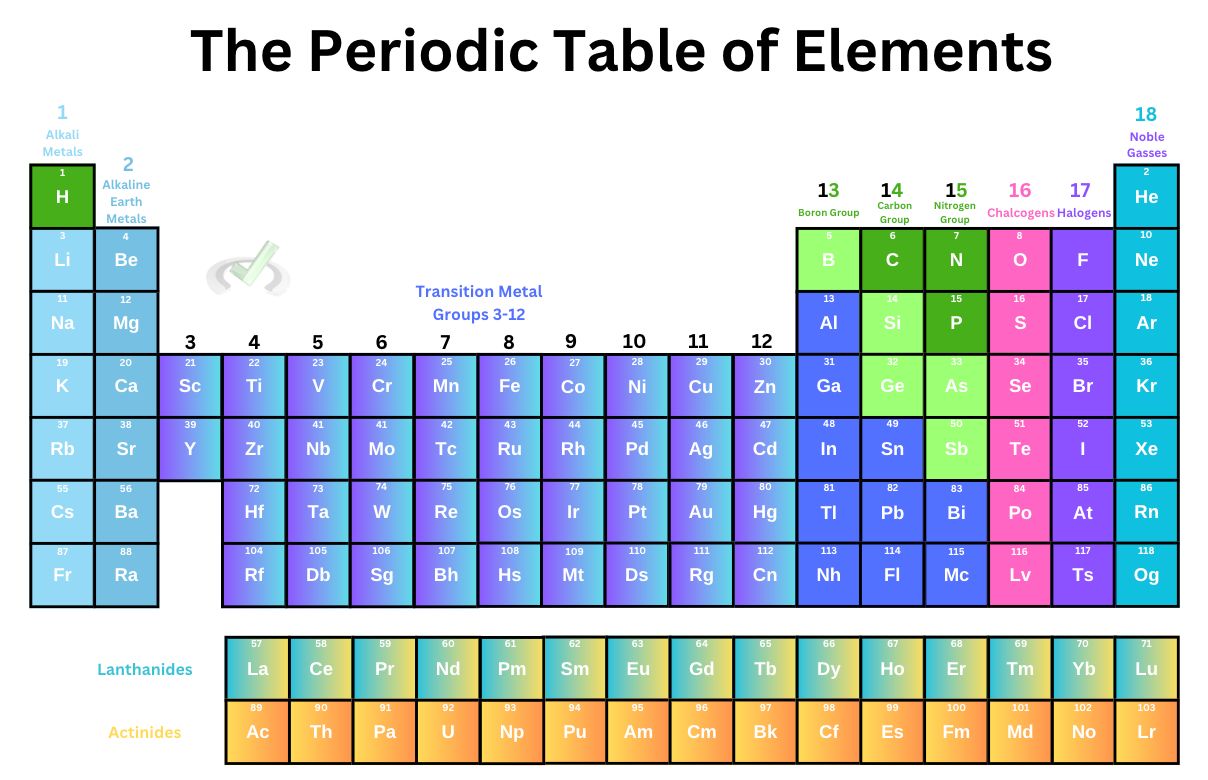
In groups 1 and 2, the number of valence electrons matches the group number. Groups 13 to 18 hold 3 to 8, so subtract 10 from the group number. Helium breaks the pattern with 2!
Older tables label the main groups 1A to 8A and the transition metals with a B. Group 16 is 6A in that system, for example.
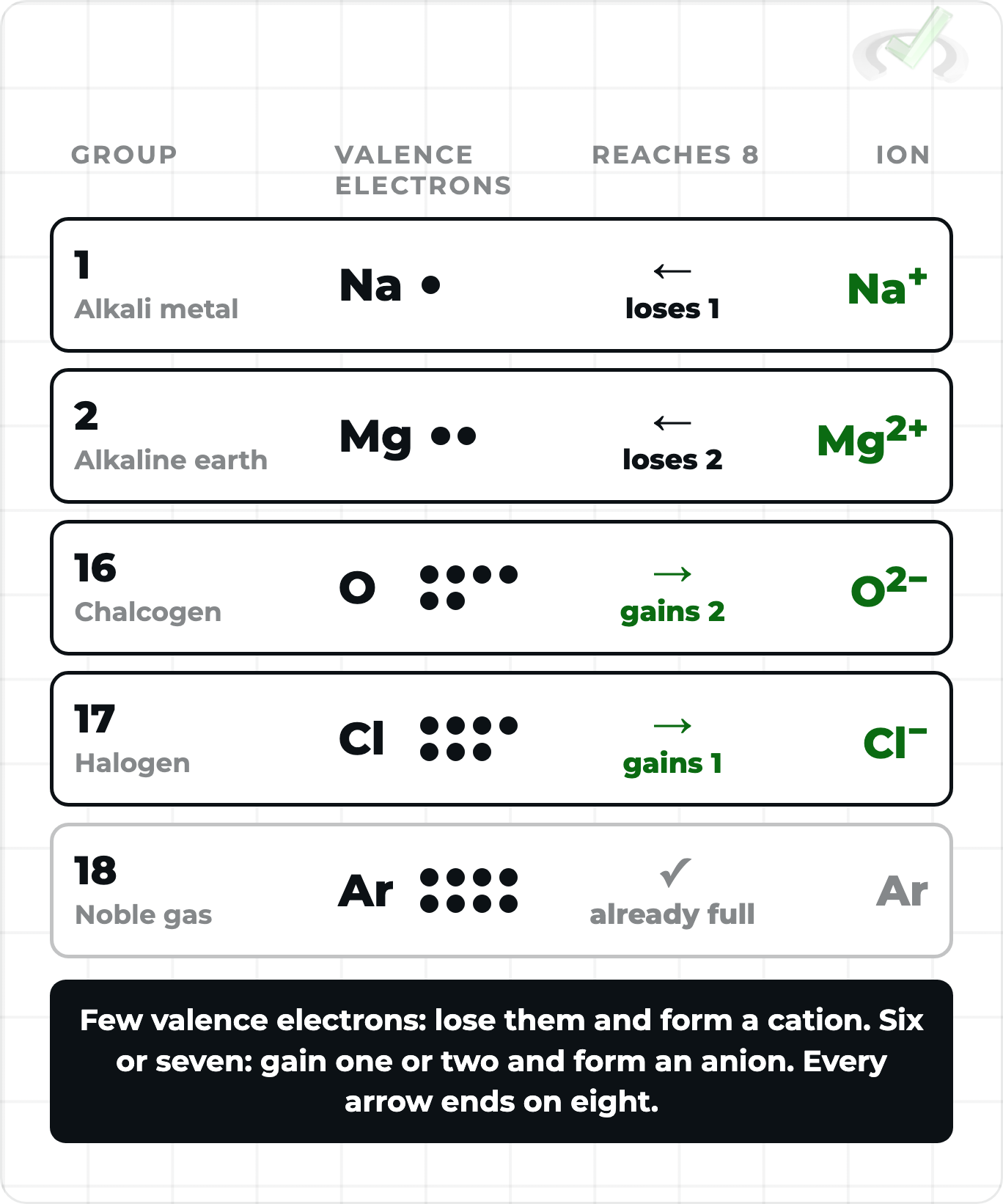
Atoms are most stable with a full valence shell, usually eight electrons (an octet). Elements with only one or two valence electrons lose them and form cations. Elements with six or seven gain one or two and form anions. It’s all about reaching eight!
An element’s group tells you its valence electrons. From there you can predict its usual charge, how reactive it is and whether it bonds ionically or covalently!
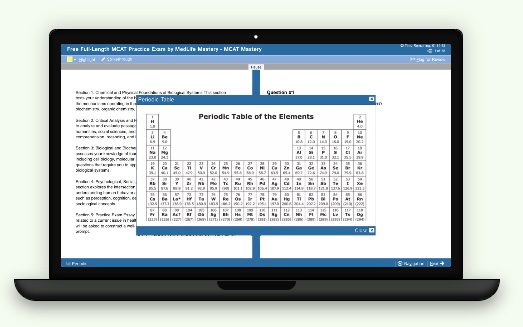
The AAMC gives you a periodic table during the Chem/Phys and Bio/Biochem sections, and it posts the same table as a free PDF. The table won’t tell you how each group behaves, so that part’s yours to learn 🙂
Our Periodic Table on the MCAT guide covers what you get on test day and the four trends behind everything below. For how the table sorts metals, nonmetals and metalloids, see our basics of the periodic table notes.
Free cheat sheet
The Periodic Trends Cheat Sheet
Electronegativity, atomic radius, ionization energy and effective nuclear charge, which way each one runs, and why. Five pages.
On its way.
Check your inbox in the next minute.
Alkali Metals and Alkaline Earth Metals (Groups 1 and 2)
Alkali metals (group 1)
The alkali metals are lithium, sodium, potassium, rubidium, cesium and francium. Each has a single valence electron in its outermost s orbital, and losing it leaves a noble gas configuration. They form +1 cations easily and have the lowest ionization energies in their periods.
They’re soft enough to cut with a knife, and they get softer down the group. They’re also light for metals, and lithium is less dense than water!
Reactivity increases down the group. Each step down adds a shell, so the valence electron sits farther from the nucleus and comes off more easily. Melting points fall down the group, from 181 °C for lithium to 28 °C for cesium.
Alkali metals react with water to make a metal hydroxide and hydrogen gas, as in 2Na + 2H2O → 2NaOH + H2. With oxygen, lithium forms lithium oxide (Li2O).
They react so readily that they’re stored under oil and never found uncombined in nature. Don’t try this one at home!
As cations, they bond ionically with anions, like the chloride in NaCl and KCl, and most of their salts dissolve in water. Hydrogen sits at the top of group 1, but it’s a nonmetal, so it isn’t an alkali metal.
Alkaline earth metals (group 2)
The alkaline earth metals are beryllium, magnesium, calcium, strontium, barium and radium. With two valence electrons, they lose both to form +2 cations, like Mg2+ and Ca2+.
Each one has one more proton than the alkali metal beside it, so its Zeff is a little higher. That makes the group 2 metals a bit smaller, harder and less reactive than group 1, with higher melting points.
Reactivity still increases down the group. Beryllium doesn’t react with water, magnesium reacts with hot water or steam, and calcium, strontium and barium react with cold water!
Melting points trend downward from beryllium, but unevenly. Magnesium has the lowest melting point in the group, at 650 °C.
Together, groups 1 and 2 are called the active metals. Calcium and magnesium ions show up all over physiology too, from bone to muscle contraction! Our valence electrons and effective nuclear charge notes explain the pull behind these trends.
Chalcogens and Halogens (Groups 16 and 17)
On the right side of the table, the chalcogens and halogens have high ionization energies, electron affinities and electronegativities. They’re one or two electrons short of an octet, so gaining electrons is the quick route to a full shell!
Chalcogens (group 16)
The chalcogens sit in group 16, the column headed by oxygen, between the nitrogen group and the halogens. They’re oxygen, sulfur, selenium, tellurium, polonium and livermorium, and each has six valence electrons.
Metallic character increases down the group. Oxygen, sulfur and selenium are nonmetals, and tellurium is a metalloid. Polonium counts as a metal on some tables and a metalloid on others, and livermorium is a synthetic element.
Oxygen and sulfur usually gain two electrons to form −2 ions, like O2− in oxides and S2− in sulfides. With other nonmetals, they share electrons in covalent bonds, as in H2O, H2S and SO2.
Oxygen and sulfur matter a lot in biology. Oxygen is part of water and nearly every biomolecule, and sulfur sits in the amino acids cysteine and methionine. Selenium is a trace nutrient that’s toxic in larger doses, and polonium is radioactive!
Oxygen is the only chalcogen that’s a gas at room temperature. Melting and boiling points rise from oxygen down to tellurium.
Halogens (group 17)
The halogens are fluorine, chlorine, bromine, iodine, astatine and tennessine. With seven valence electrons, they gain one electron to form −1 anions called halides, like F−, Cl−, Br− and I−.
As elements, they exist as diatomic molecules (F2, Cl2, Br2 and I2). At room temperature, fluorine and chlorine are gases, bromine is a liquid and iodine is a solid. Fluorine is the most electronegative element of all!
They bond ionically with the alkali and alkaline earth metals, as in NaCl and CaCl2, and covalently with other nonmetals, as in HCl. Our ionic bonds and covalent bonds notes cover both.
Reactivity decreases down the group, so fluorine is the most reactive halogen. A bigger atom pulls an incoming electron in less strongly. Melting and boiling points rise down the group, since bigger molecules have stronger London dispersion forces between them.
Elemental halogens are toxic, and fluorine and chlorine are dangerous gases to breathe. We’ll stick to drawing them!
Down groups 1 and 2, reactivity increases. These metals react by losing electrons, and bigger atoms lose them more easily.
Down group 17, reactivity decreases. Halogens react by gaining electrons, and bigger atoms attract them less!
Noble Gases (Group 18)
The noble gases are helium, neon, argon, krypton, xenon, radon and oganesson. Every one has a full valence shell, eight electrons for all of them except helium, which has two (1s2).
Neon’s octet is 2s2 2p6, and argon’s is 3s2 3p6. Argon’s third shell can hold up to 18 electrons once 3d fills, but the eight in 3s and 3p already give argon a full valence shell.
With nothing to gain or lose, they barely react, so they’re also called the inert gases. They have very high ionization energies and electron affinities close to zero, and helium, neon and argon have no measured electronegativity.
The heavier noble gases can react under harsh conditions. Xenon forms a handful of compounds with fluorine and oxygen, like XeF2 and XeF4. Not so noble after all!
They’re colorless, odorless gases made of single atoms. Their boiling points are very low and rise down the group, and helium has the lowest boiling point of any element, at −269 °C.
Since they don’t react, argon fills light bulbs and helium fills party balloons!
Transition Metals (Groups 3 to 12)
Transition metals fill the middle of the table, in groups 3 to 12. They’re the d-block elements, since their highest-energy electrons fill a d subshell.
Like other metals, they have low ionization energies, electron affinities and electronegativities. Most are hard, with high melting and boiling points, and they conduct heat and electricity well. Mercury is the exception, since it’s a liquid at room temperature!
Copper conducts electricity so well that it’s the metal in most electrical wiring!
Why transition metals have several oxidation states
Their 4s and 3d electrons sit close in energy, so a transition metal can lose different numbers of them. Iron shows up as Fe2+ or Fe3+, and copper as Cu+ or Cu2+.
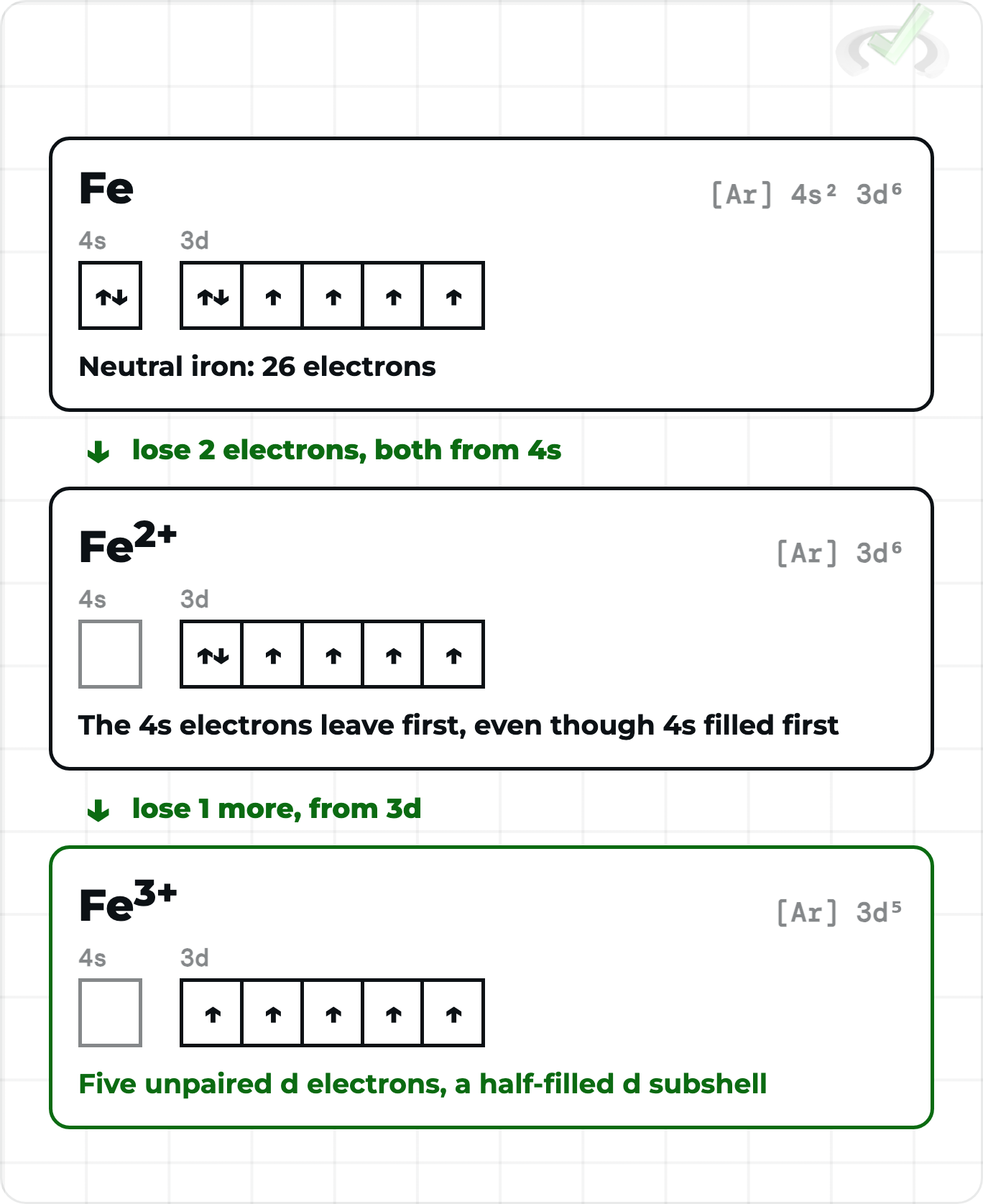
When a transition metal forms a cation, it loses its 4s electrons before its 3d electrons. Iron loses both 4s electrons to become Fe2+, then one 3d electron to become Fe3+. Our electron configuration notes cover how these subshells fill.
In the first row, the number of common oxidation states climbs toward the middle. Manganese has the widest range, from +2 up to +7! Scandium (+3) and zinc (+2), at the two edges, usually show only one.
Our assigning oxidation numbers notes show how to work out the charge on a metal inside a compound.
Is group 12 a transition metal group?
Group 12 holds zinc, cadmium, mercury and copernicium. Most tables, ours included, count groups 3 to 12 as the transition metals.
The IUPAC definition is stricter, though. It asks for a partly filled d subshell, and zinc, cadmium and mercury keep a full d10 subshell even as ions, so some chemists leave group 12 out.
On the MCAT, you’re safe calling it the last column of the d-block :)
Color and complex ions
Many transition metal compounds are brightly colored. When a transition metal ion bonds to surrounding molecules in a complex, its d orbitals split into two energy levels. The ion absorbs the light that matches that gap, and you see the colors left over!
Zinc compounds are usually white, since a full d10 subshell has no room for that jump. The lanthanides and actinides, the two rows under the main table, are the f-block, sometimes called the inner transition metals.
Melting and Boiling Point Trends on the Periodic Table
Melting and boiling points change in opposite directions down a group, depending on what holds the particles together. Metals and nonmetals show the clearest contrast!
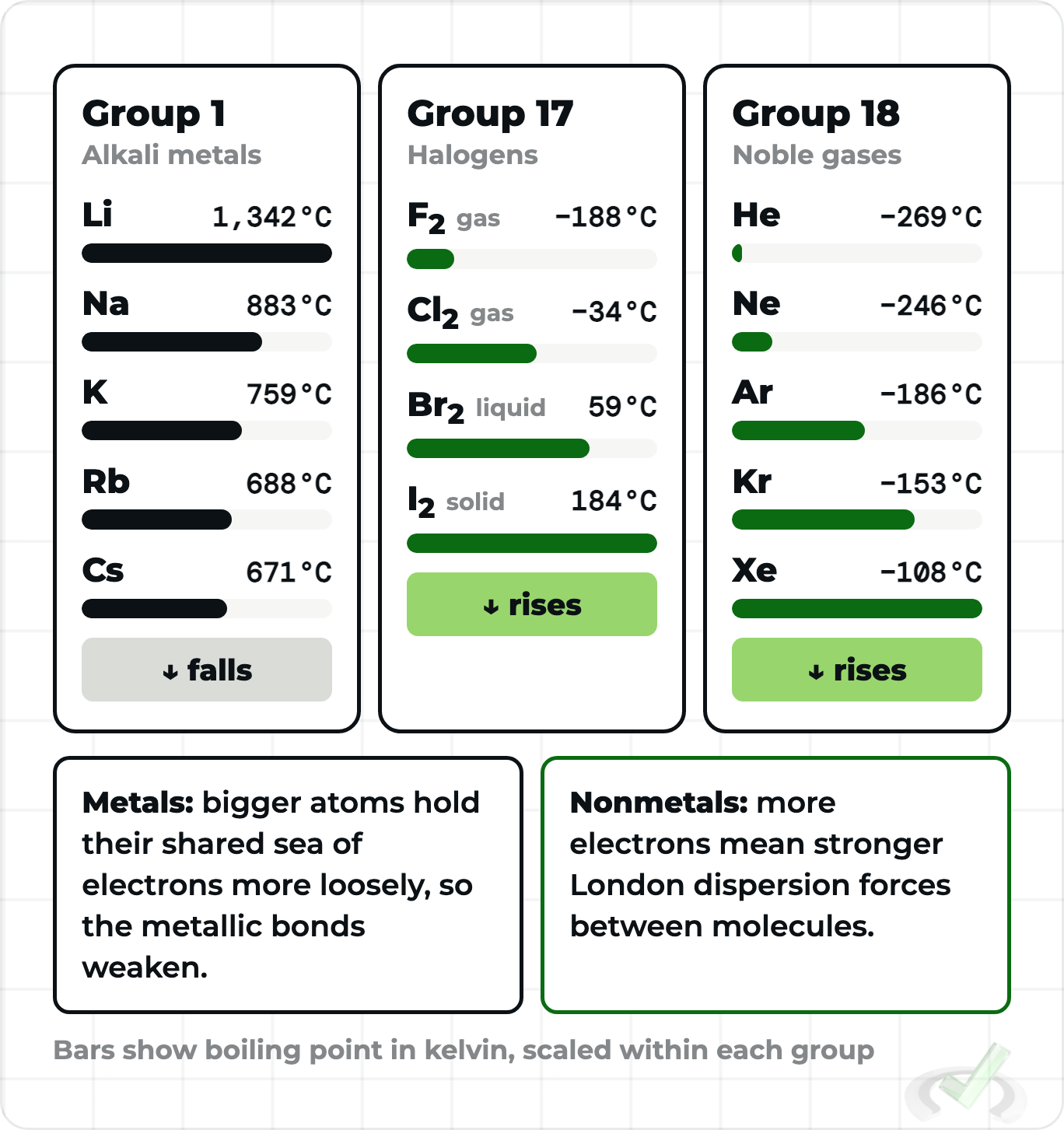
Down a group of metals, they fall
In groups 1 and 2, the atoms are held together by metallic bonds, with valence electrons shared across the whole solid. Bigger atoms hold that shared sea of electrons more loosely, so the bonds weaken.
So melting and boiling points fall steadily down group 1, from a boiling point of 1,342 °C for lithium to 671 °C for cesium. Group 2 falls unevenly, and magnesium sits lowest.
Down a group of nonmetals, they rise
Halogens and noble gases exist as separate molecules or atoms, held to each other by London dispersion forces. More electrons make a bigger, more polarizable electron cloud, so those forces grow stronger down the group.
That’s why fluorine is a gas and iodine is a solid! Our types of intermolecular forces notes go deeper on London dispersion forces.
Across a period
Across period 3, melting points climb from sodium (98 °C) to a peak at silicon (1,414 °C), which forms a giant covalent network. They fall far lower for phosphorus, sulfur, chlorine and argon, which exist as small molecules or single atoms.
Chlorine and argon are even gases at room temperature!
- In group 1, melting and boiling points fall down the group, and group 2 trends down unevenly
- In groups 17 and 18, melting and boiling points rise down the group
- Across a period, melting points peak in the middle, around group 14, then drop
Our main trends of the periodic table notes cover atomic radius, ionization energy, electron affinity and electronegativity the same way, if you’d like more!
(Optional) If you’d like to work through trend questions in full passages with a top scorer beside you, our 6-Week Live MCAT Accelerator runs 12 live strategy classes taught by a 520+ scorer.
Important Definitions and Key Terms
Practice Questions on Chemical Groups
Question 1. Which of the following is not likely to be true?
- Halogens have 7 valence electrons, which means they readily give up 7 electrons to form a bond.
- Chalcogens have 6 valence electrons, which means they readily accept 2 electrons to form a bond.
- Alkali metals can form a bond by donating an electron.
- Alkaline earth metals can donate 2 electrons to form a bond.
Show the answer
A. Halogens gain one electron to reach an octet. Giving up all seven would cost far too much energy. B, C and D each describe how a group reaches eight. Nice work if you got it!
Question 2. All of the following statements are true except:
- Noble gases rarely form bonds with other elements.
- Halogens can be toxic in various forms.
- Metallic character increases as we move up the group for chalcogens.
- Noble gases are inert.
Show the answer
C. Metallic character increases down group 16, from oxygen, a nonmetal, to tellurium, a metalloid. Going up the group, it decreases. That one’s a sneaky wording trap!
Question 3. Which of these halogens has the lowest boiling point?
- F2
- Cl2
- Br2
- I2
Show the answer
A. F2 has the fewest electrons, so its London dispersion forces are the weakest. It boils at −188 °C, and the boiling point rises down the group!
Question 4. Which ion has the electron configuration [Ar] 3d5?
- Fe2+
- Fe3+
- Mn3+
- Cr3+
Show the answer
B. Iron is [Ar] 4s2 3d6. It loses both 4s electrons and then one 3d electron, leaving 3d5. Fe2+ is 3d6, Mn3+ is 3d4 and Cr3+ is 3d3. Remember, 4s leaves first!
(Optional) To see how top scorers work through questions like these in full passages, our Chem/Phys & Bio/Biochem Mastery Course has 100+ strategy video lessons and AAMC passage walkthroughs from 130+ scorers.
Periodic Table MCAT FAQs on Chemical Groups
Do you get a periodic table on the MCAT?
Yes! The AAMC gives you a periodic table during the Chem/Phys and Bio/Biochem sections, and you can practice with the same AAMC periodic table PDF. Our periodic table MCAT guide has the details.
Where are the chalcogens on the periodic table?
In group 16, the column headed by oxygen. They sit between the nitrogen group (15) and the halogens (17), and each has six valence electrons!
What group is 12 on the periodic table?
Group 12 is the zinc group (zinc, cadmium, mercury and copernicium), the last column of the d-block. Most tables count it with the transition metals, though IUPAC’s stricter definition leaves it out.
What are the alkali metals, alkaline earth metals, halogens and noble gases?
They’re groups 1, 2, 17 and 18. The alkali metals form +1 ions, the alkaline earth metals form +2 ions, the halogens form −1 ions and the noble gases barely react!
Does melting point increase down a group?
It depends on the group. Melting and boiling points rise down the halogens and the noble gases, since London dispersion forces grow. They fall down the alkali metals, since metallic bonds weaken!
Which chemical groups should I know for the MCAT?
Know groups 1, 2, 16, 17 and 18 and the transition metals, with their valence electrons, usual charges and reactivity trends. Those cover most periodic table MCAT questions about groups!
Final Thoughts on Specific Chemical Groups
Every group on this page comes back to its valence electrons. Count them, decide whether the element loses or gains electrons to reach eight, and the charge, the reactivity and the bonding follow!
If you’d like help building that habit, our 6-Week Live MCAT Accelerator pairs live strategy classes with seven 1:1 sessions with a 515+ scorer.
If the cohort dates don’t line up with your test, 1:1 MCAT tutoring with a 515+ scorer works at your own pace, and if Chem/Phys is your weakest section, we’ll match you with a 130+ C/P scorer.
You’ve got this, and we’re rooting for you :)
Supplemental Resources
Want to go deeper on this topic? Here's where to read, watch and practice it next.
Read
- Kaplan MCAT General Chemistry Review 2026-2027, §2.4
- The Princeton Review MCAT General Chemistry Review, sections 4.7 through 4.8
Watch

- “Groups of the periodic table” (Khan Academy)
- “Transition Metals” (Khan Academy)
Get the Periodic Trends cheat sheet
On its way.
Check your inbox in the next minute.




 To help you achieve your goal MCAT score, we take turns hosting these