
Organic chemistry runs two naming systems side by side! IUPAC names follow a strict set of rules. Common names, like acetone and isopropyl alcohol, come from history and everyday use, and the MCAT uses both.
This study note covers the common names and substituents you’ll meet most, with a structure for each one, so you can turn a name into a drawing on test day. Let’s get started!
What Are Substituents in Organic Chemistry?
A substituent is an atom or group that replaces a hydrogen on a molecule’s parent chain or ring. Substituents come first in a name as prefixes, and the parent chain comes last. In 2-methylpentane, methyl is the substituent and pentane is the parent!
Carbon substituents swap the -ane ending for -yl, so methane becomes methyl and ethane becomes ethyl. Chemists also write R for any alkyl group and Ar for any aryl (aromatic ring) group.
The IUPAC naming rules give every molecule one systematic name. Many molecules kept an older common name too, and some of those, like acetone, are what everyone calls them!
A question can say isopropyl alcohol while the answer choices say 2-propanol. They’re the same molecule, and spotting that is a free point 🙂
Organic chemistry makes up about 15% of the Chem/Phys section, by the AAMC’s estimate, and names show up in every orgo passage. This page builds on our MCAT organic chemistry nomenclature guide and its naming fundamentals.
Free cheat sheet
The IUPAC Nomenclature Cheat Sheet
Prefix, parent and suffix in order, the lowest locant rule, and naming alkanes, alkenes and alkynes. Four pages.
On its way.
Check your inbox in the next minute.
Alkyl Substituents: Isopropyl, Sec-Butyl, Tert-Butyl and More
With one hydrogen removed, a carbon chain becomes an alkyl group that can bond to something else. Here are the ones you’ll see most, with their common names and their systematic IUPAC names!
What n-, iso-, sec-, tert- and neo- mean
All four butyl groups have four carbons. The prefix tells you which carbon makes the attachment, and that’s what you need to draw the structure from the name!
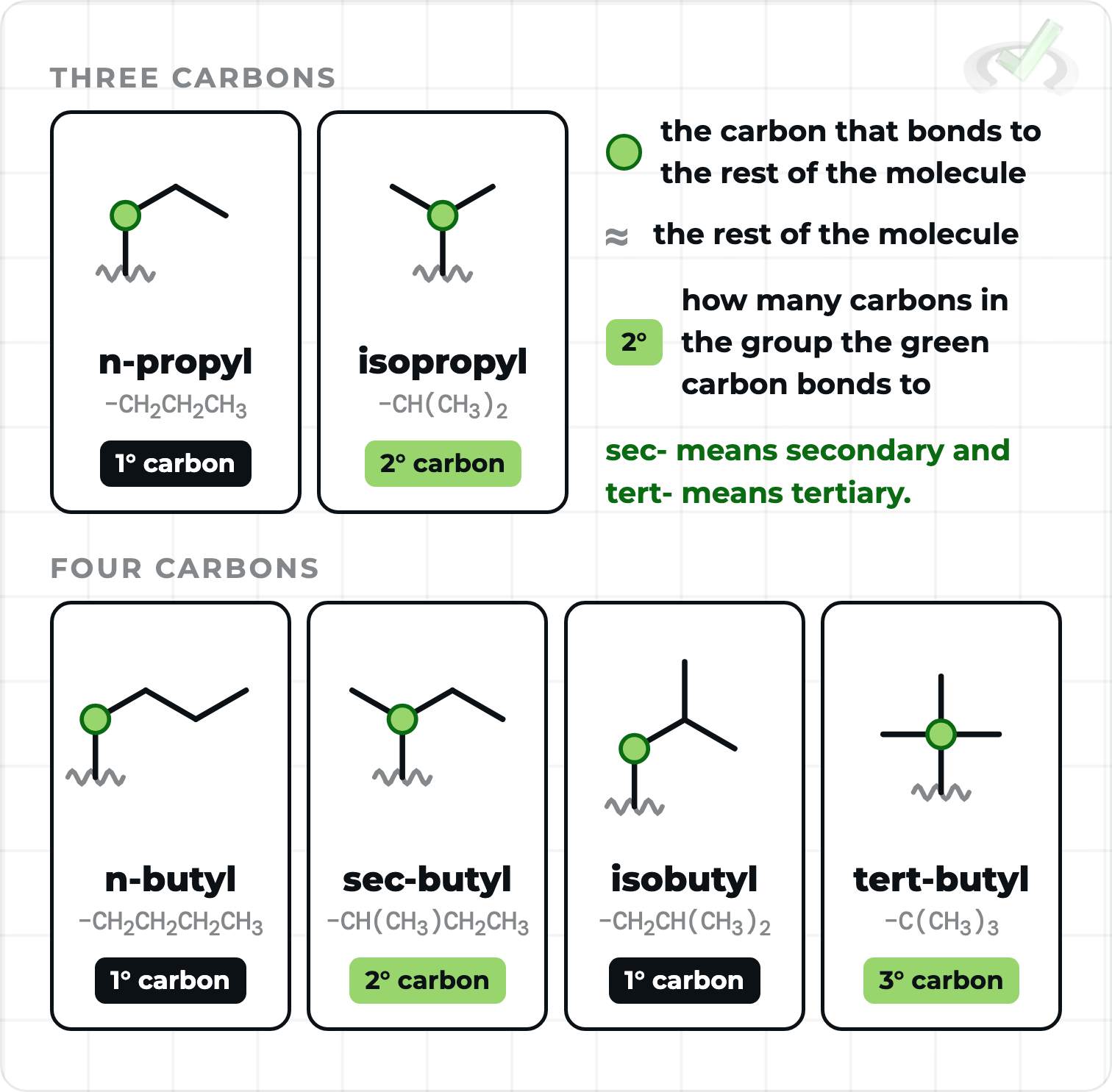
- An n- (normal) group is an unbranched chain, attached at an end carbon.
- An iso- group’s far end splits into two methyls, (CH3)2CH−, like isopropyl and isobutyl.
- A sec- (secondary) group attaches through a carbon bonded to two other carbons.
- A tert- (tertiary) group attaches through a carbon bonded to three other carbons.
- A neo- group has a carbon carrying three methyls at the far end, so neopentyl is a CH2 attached to a tert-butyl group.
IUPAC’s 2013 rules prefer the systematic names for isobutyl, sec-butyl and neopentyl, and they keep isopropyl and tert-butyl. You’ll still see all five common names in textbooks and exam questions, so it helps to know both versions!
Vinyl, Allyl, Phenyl and Benzyl Groups
These four carry a double bond or a benzene ring, and they come in two pairs. In each pair, the second group is the first one with a CH2 added between it and the rest of the molecule!
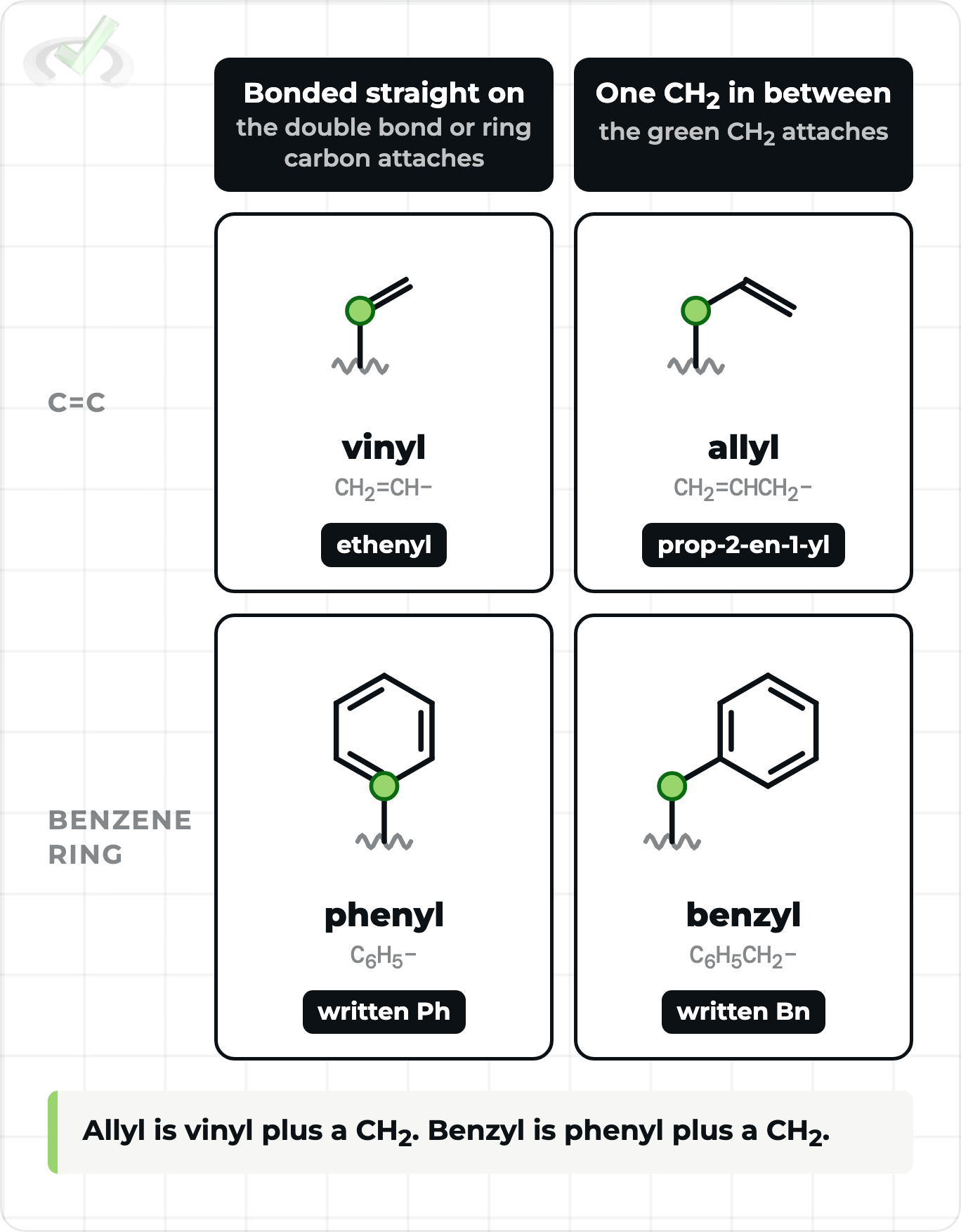
- Vinyl (CH2=CH−, IUPAC ethenyl) bonds through a carbon of the double bond. Vinyl chloride is the building block of PVC plastic.
- Allyl (CH2=CHCH2−) bonds through the CH2 next to the double bond. The name comes from garlic, Allium sativum.
- Phenyl (C6H5−, written Ph) is a benzene ring bonded straight to the molecule. It’s the simplest aryl group.
- Benzyl (C6H5CH2−, written Bn) is a benzene ring with a CH2 between it and the molecule.
If the ring carbon bonds to the molecule, it’s phenyl. If a CH2 sits between them, it’s benzyl. Benzene itself is C6H6, so phenyl has 5 hydrogens on the ring and benzyl keeps those 5 and adds 2 more!
List of Substituents in Organic Chemistry
Beyond the carbon groups, these are the substituents you’ll run into most often! Each has a prefix name for when it isn’t the molecule’s main functional group.
Which groups get a prefix depends on priority. The highest-priority group takes the suffix and every other group becomes a prefix. Our priority ordering of functional groups notes walk through the full ranking!
Ethers have two kinds of names. In IUPAC names they take an alkoxy prefix, like methoxymethane. Their common names list both alkyl groups and add ether, like dimethyl ether and diethyl ether.
Common Names of Organic Compounds
Some molecules go by their common names almost everywhere! These tables pair each one with its IUPAC name and formula. The carbonyl compounds, with their own naming pattern, are in the next section.
Hydrocarbons and alcohols
A common alcohol name is the alkyl group plus the word alcohol. Ethyl alcohol is ethanol, isopropyl alcohol is propan-2-ol, and tert-butyl alcohol is 2-methylpropan-2-ol. Our alcohol and ether naming notes have more examples!
Aromatic compounds
Benzene with one substituent often keeps an older name. IUPAC still uses several of them, like phenol, aniline and benzoic acid, as official names!
Ethers, esters and halides
Form-, Acet- and Propion-: Common Names for Carbonyls
Aldehydes and carboxylic acids share one set of common-name prefixes, and each prefix is a carbon count. Learn four prefixes and you’ve got eight names!
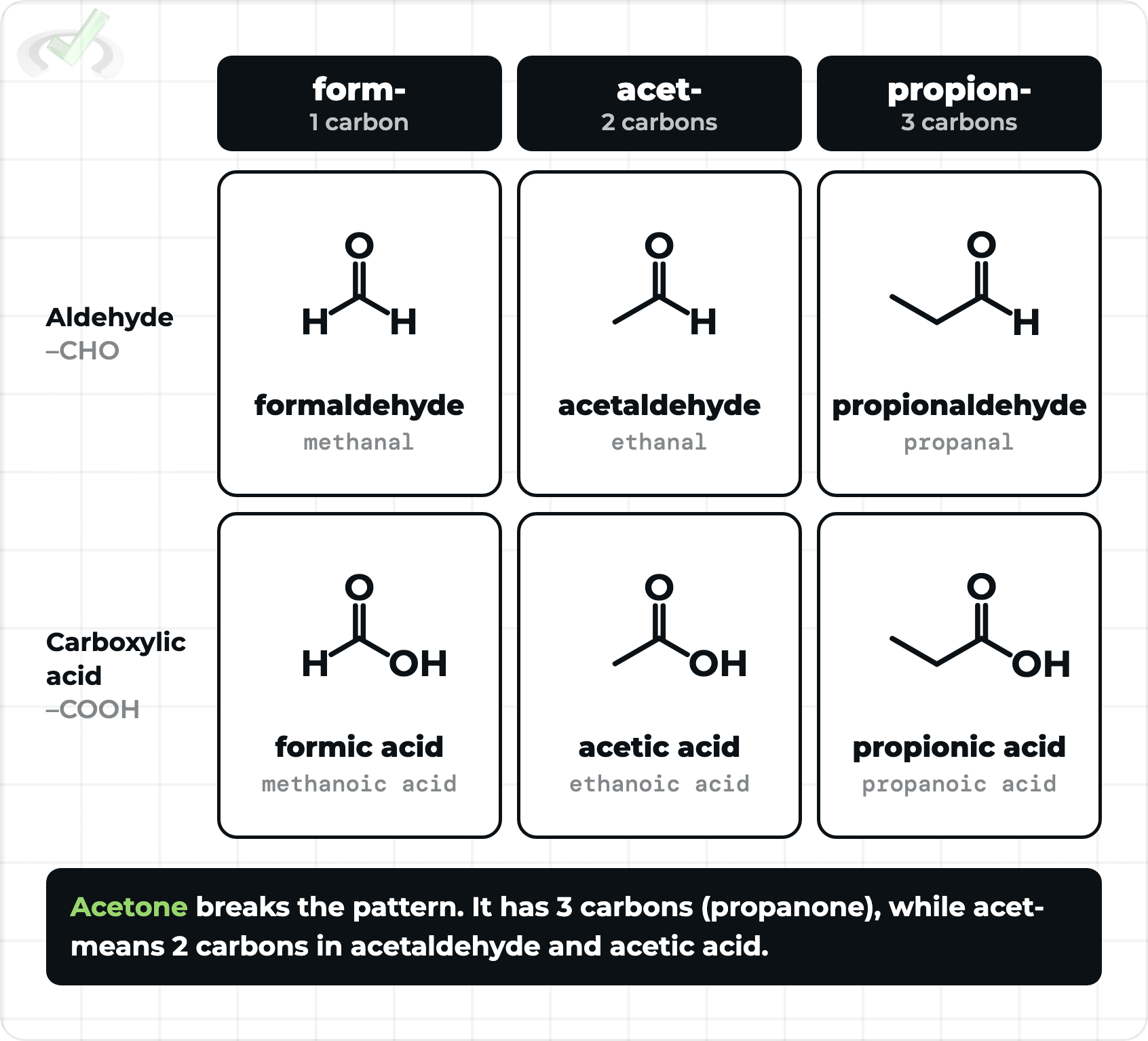
form- is 1 carbon, acet- is 2, propion- is 3 and butyr- is 4. Butyraldehyde is butanal, and butyric acid (the smell of rancid butter) is butanoic acid!
Ketones
For ketones, the common name lists the two alkyl groups on the carbonyl in alphabetical order and adds ketone. Butanone is ethyl methyl ketone, which you’ll also see written as methyl ethyl ketone (MEK).
Acetone (propanone) is the simplest ketone and the solvent in many nail polish removers. Its three carbons make it the exception to the acet- pattern!
Where three of these names come from
- Formaldehyde (methanal), the simplest aldehyde, is used in embalming and disinfection.
- Formic acid (methanoic acid) is in ant stings. The name comes from formica, Latin for ant.
- Acetic acid (ethanoic acid) is the acid in vinegar, and acetaldehyde (ethanal) oxidizes to it.
Our aldehyde and ketone naming notes and carboxylic acid naming notes go deeper on each family!
If you’d like to see how top scorers use names like these to read orgo passages fast, our Chem/Phys & Bio/Biochem Mastery Course has 100+ strategy video lessons by 130+ C/P and B/B scorers.
How Substituents Change Reactions on the MCAT
Because a name tells you the structure, it also tells you a lot about the reaction. Here’s what the common substituent names tell you before you draw anything!
Aldehydes react faster than ketones in nucleophilic addition. A ketone’s second alkyl group crowds the carbonyl carbon and donates electron density, which makes that carbon less positive.
Our SN1 vs SN2 notes and alcohol redox notes cover both reactions in full!
Substituents on a benzene ring
On a benzene ring, a substituent changes how fast the ring reacts with electrophiles and where the next group lands. That splits ring substituents into three groups.
- Electron-donating groups (like −OH, −NH2, −OCH3 and alkyl groups) activate the ring and direct ortho and para.
- Electron-withdrawing groups (like −NO2, −COOH and −CHO) deactivate the ring and direct meta.
- Halogens deactivate the ring but still direct ortho and para.
(Optional) If you’d like to practice reading names like these in full passages with a top scorer beside you, our 6-Week Live MCAT Accelerator runs 12 live classes taught by a 520+ scorer.
Substituents You’ll See in Amino Acids
The substituent names come back in biochemistry! Several amino acid side chains are groups from this page, so the names help you picture the structures.
Along with its side chain, every amino acid carries an amino group and a carboxyl group. Our amino acid structure notes walk through all 20 side chains!
Common Names and Substituents: Terms to Know
Here’s a quick review of the terms on this page!
Practice Questions
Try these before you open the answers!
Question 1
What is the IUPAC name for CH3OH?
A) Ethanol
B) Methanol
C) Propanol
D) Isopropanol
Show the answer
B. Methanol is the IUPAC name. Its common names are methyl alcohol and wood alcohol, and it’s used as a solvent and antifreeze.
Question 2
Which substituent is represented by the group −NH2?
A) Hydroxyl
B) Methyl
C) Amino
D) Carbonyl
Show the answer
C. The −NH2 group is an amino group, found in amines and amino acids.
Question 3
Which alkyl group bonds to the rest of the molecule through a tertiary carbon?
A) Isobutyl
B) sec-Butyl
C) tert-Butyl
D) n-Butyl
Show the answer
C. Tert-butyl attaches through a carbon bonded to three methyl groups. Sec-butyl attaches through a secondary carbon, and isobutyl and n-butyl through a primary CH2.
Question 4
A molecule carries a −CH2CH=CH2 group. What is it called?
A) Vinyl
B) Allyl
C) Propyl
D) Benzyl
Show the answer
B. Allyl is a CH2 attached to a vinyl group. Vinyl has no CH2 spacer, propyl has no double bond and benzyl carries a benzene ring.
Question 5
What is the common name of propanone?
A) Acetaldehyde
B) Propionaldehyde
C) Acetone
D) Acetic acid
Show the answer
C. Propanone is acetone, the simplest ketone. Acetaldehyde is ethanal, propionaldehyde is propanal and acetic acid is ethanoic acid.
Common Names and Substituents FAQs
What are substituents in organic chemistry?
Substituents are atoms or groups that replace a hydrogen on a molecule’s parent chain or ring, like methyl, chloro or hydroxy. They’re named as prefixes in front of the parent name!
What’s the difference between a common name and an IUPAC name?
An IUPAC name comes from a fixed set of rules, so it describes the structure. A common name comes from history or everyday use. Acetone and propanone are the same molecule.
What is the common name of CH3OH?
Methyl alcohol, also called wood alcohol. Its IUPAC name is methanol.
What’s the difference between phenyl and benzyl?
Phenyl (C6H5−) is a benzene ring bonded straight to the molecule. Benzyl (C6H5CH2−) has a CH2 between the ring and the molecule.
What’s the difference between acetone and formaldehyde?
Acetone, (CH3)2CO, is a three-carbon ketone called propanone. Formaldehyde, HCHO, is a one-carbon aldehyde called methanal. Both have a carbonyl group!
Do you need to know common names for the MCAT?
Yes. Questions can use names like acetone, acetic acid, isopropyl alcohol or tert-butyl without giving the IUPAC name. The tables on this page and our MCAT organic chemistry nomenclature guide cover the ones to know!
Final Thoughts on Common Names and Substituents
Common names and substituents are the vocabulary of organic chemistry. Once the prefixes click, a name like tert-butyl alcohol turns into a structure in your head, and orgo passages get faster to read!
If you’d like help building that skill, our 6-Week Live MCAT Accelerator pairs live strategy classes with seven 1:1 sessions with a 515+ scorer.
If the cohort dates don’t line up with your test, 1:1 MCAT tutoring with a 515+ scorer works at your own pace, and if Chem/Phys is your weakest section, we’ll match you with a 130+ C/P scorer.
You’ve got this, and we’re rooting for you :)
Supplemental Resources
Want to go deeper on this topic? Here's where to read, watch and practice it next.
Read
- Kaplan MCAT Organic Chemistry Review 2026-2027, §1.1 and §1.3 and §1.4
Watch

- “Common and systematic naming: iso-, sec-, and tert- prefixes” (Khan Academy)
- “Naming benzene derivatives” (Khan Academy)
Get the IUPAC Nomenclature cheat sheet
On its way.
Check your inbox in the next minute.



 To help you achieve your goal MCAT score, we take turns hosting these