
Think about a time you heard an echo in a canyon or noticed patterns formed by oil on water. These observations illustrate the wave phenomena.
Other wave phenomena exist beyond the commonly known properties of light waves. These include diffraction, interference, and reflection.
These concepts help us understand light, sound, and water waves. Let's explore in detail the fundamental principles of waves and their applications.
I. Introduction to Other Wave Phenomena
Waves are types of disturbances that transfer energy from one place to another. They can be mechanical, like sound and water waves. These types of waves require a medium to travel through.
They can also be electromagnetic, like light waves, which can travel through a vacuum. Understanding various wave phenomena helps us comprehend how waves behave in different situations.
Free cheat sheet
The Sound & Waves Cheat Sheet
Frequency, wavelength, amplitude and velocity, plus photon energy and where Planck's constant comes in. Three pages.
On its way.
Check your inbox in the next minute.
II. Properties of Waves
Waves have several key properties that define their behavior and impact. Understanding these properties helps us grasp how waves work in different contexts.
A. Wavelength and Frequency
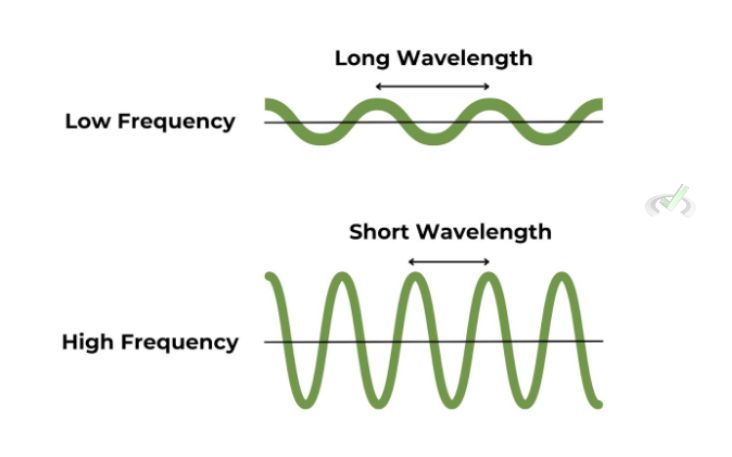
The wavelength of a wave is the distance between successive peaks. It is usually measured in meters for sound waves or nanometers for light waves. Frequency is the number of wave cycles that go through a point in one second, measured in Hertz (Hz).
These two properties are related. As the wavelength decreases, the frequency increases, and vice versa. For example, sound waves have wavelengths ranging from millimeters to meters. Meanwhile, light waves have much shorter wavelengths.
B. Amplitude
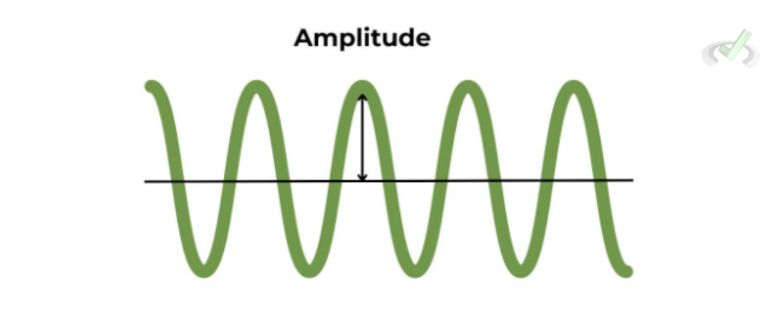
A wave's amplitude is the wave's height from its midpoint to its peak. This property is related to the intensity or loudness of the wave. Higher amplitude means louder sound or brighter light. The wave's energy is also proportional to the square of the amplitude.
C. Speed of Waves
Waves travel at different speeds, and it depends on the medium. For example, sound waves travel about 343 meters per second in air but can travel faster in water.
Light waves travel at an incredible speed of about 300,000 kilometers per second in a vacuum. The speed can change when waves pass through different materials, like when light slows down in water or glass.
III. Behavior of Waves
Waves interact with materials in various ways, explaining many everyday phenomena.
A. Reflection
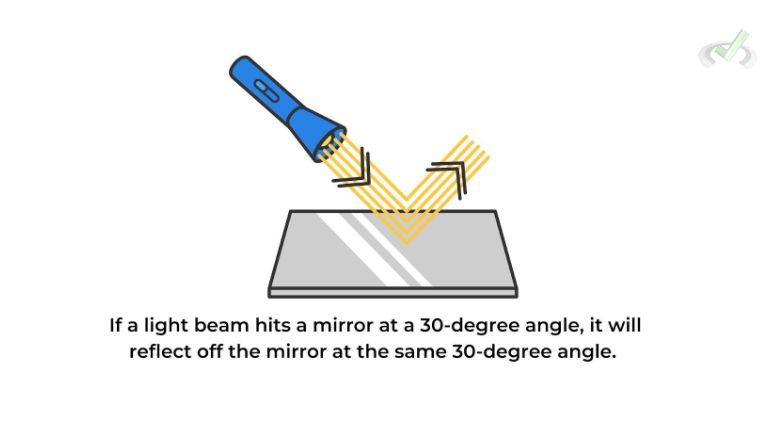
Reflection occurs when waves bounce off a surface. The angle at which the wave hits the surface (angle of incidence) is equal to the angle at which it reflects off the surface (angle of reflection).
This principle, known as the law of reflection, is why we can see our reflection in a mirror. When you look at yourself in a mirror, the light from your face reflects into your eyes.
B. Refraction
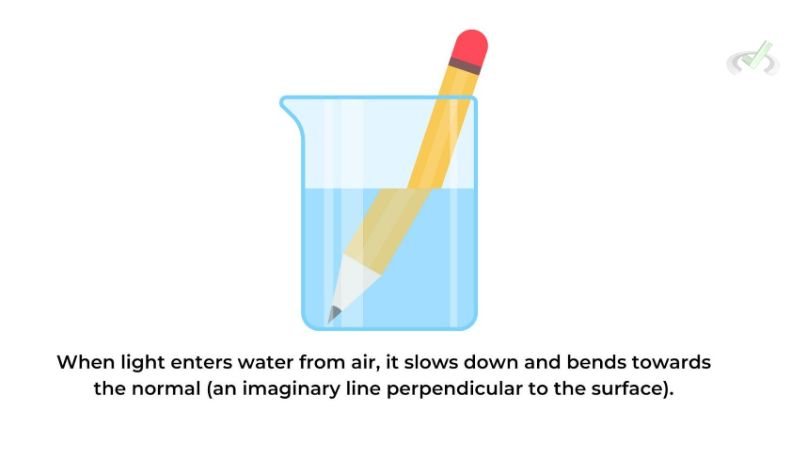
Refraction occurs whenever waves pass from one medium to another and change speed, causing them to bend. A typical example is a straw that appears bent when partially submerged in water.
The degree of bending greatly depends on the refractive index of the materials involved. The refractive index measures how much a material can bend waves.
C. Diffraction
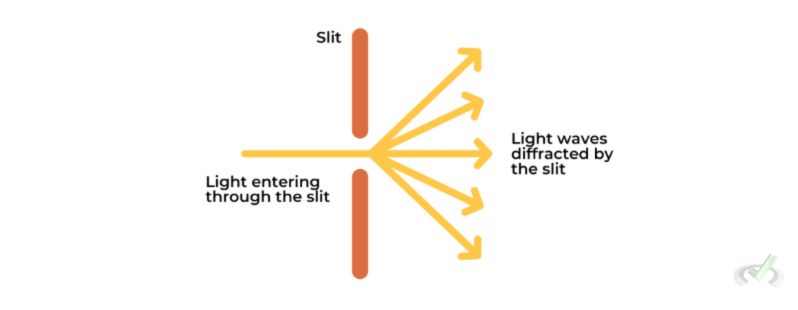
Diffraction happens when the waves bend around the edges of an obstacle or even through a narrow opening. This property can create patterns of light and dark bands, known as interference patterns.
Diffraction is more noticeable if the obstacle or opening’s size is comparable to the wavelength of the wave. For instance, sound waves can bend around a corner. It lets you hear someone talking even if they are out of sight.
D. Interference
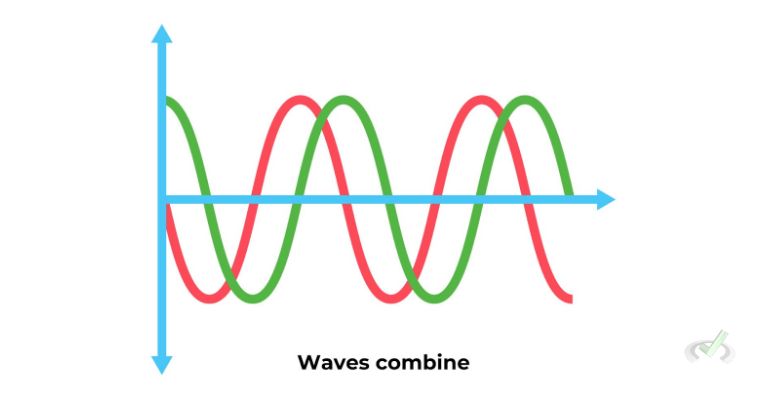
Interference occurs whenever two or more waves overlap and combine. Depending on how the waves align, the resulting wave pattern can be brighter or louder (constructive interference) or dimmer or softer (destructive interference).
This principle is used in noise-canceling headphones and scientific instruments to measure tiny distances. For example, when light waves from two sources meet, they can create a pattern of bright and dark spots.
E. Standing Waves, Resonance and Harmonics
When a wave reflects off a boundary, the reflected wave travels back through the incoming one. If both have the same frequency, they interfere to form a standing wave, a pattern that seems to stay in place and only changes in amplitude.
Points that don't move at all are called nodes. Points halfway between nodes swing with the largest amplitude and are called antinodes.
Only certain wavelengths fit a medium of a given length, because each boundary forces a node or an antinode. A fixed end of a string and the closed end of a pipe are nodes.
The open end of a pipe is an antinode. Each allowed pattern is a harmonic, and the lowest one (n = 1) is the fundamental frequency.
- String fixed at both ends. λ = 2L/n and f = nv/2L, where n = 1, 2, 3 and so on.
- Pipe open at both ends. Same formulas, λ = 2L/n and f = nv/2L, with n = 1, 2, 3 and so on.
- Pipe closed at one end. λ = 4L/n and f = nv/4L, and n can only be odd (1, 3, 5 and so on).
A closed pipe always holds an odd number of quarter-wavelengths, so its even harmonics don't exist and its first overtone is the third harmonic.
In all three formulas, L is the length of the string or pipe and v is the wave speed in that medium. Tighten a string and its waves travel faster, which raises every harmonic.
These allowed frequencies are the object's natural, or resonant, frequencies. If something pushes on the system at one of them, each push adds energy in step with the motion and the amplitude builds up. That's resonance.
Damping from friction and air resistance keeps the amplitude from growing forever. Strike a tuning fork and a matching fork across the room starts humming for this reason, while a fork tuned to a different frequency won't respond.
A pipe 0.85 m long is closed at one end, and sound travels at 340 m/s. What are its three lowest frequencies?
The fundamental is f = v/4L = 340 / (4 × 0.85) = 100 Hz. Since only odd harmonics are allowed, the next two are 3 × 100 = 300 Hz and 5 × 100 = 500 Hz.
If you open the closed end, it becomes an open pipe with f = v/2L = 340 / 1.7 = 200 Hz. Closing one end of a pipe halves its fundamental and drops the pitch an octave, and that's a favorite MCAT comparison.
IV. Applications of Wave Phenomena
Wave phenomena have various applications in various fields, from technology to nature.
A. Communication
Waves are utilized in communication systems to transmit data over long distances with minimal loss. Radio waves, microwaves, and infrared waves are all used in different types of communication.
For example, radio waves transmit signals for radio and television broadcasts. Fiber optic cables use light waves to carry internet data at high speeds.
B. Medicine
In medicine, waves are used in procedures like ultrasound imaging and laser surgery. Ultrasound waves can create images of the inside of the body, helping doctors diagnose and monitor conditions. Lasers, which use light waves, can precisely cut tissue or destroy tumors.
C. Nature and Everyday Life
Waves are a fundamental part of nature and everyday life. Ocean waves, sound waves, and light waves all demonstrate the principles of wave behavior. Understanding these principles helps us appreciate the natural world and the technology we use daily.
V. Scientific Principles of Wave Phenomena
Understanding wave phenomena helps us connect to other important scientific concepts covered in various fields.
A. Electromagnetic Spectrum
The electromagnetic spectrum encompasses all types of electromagnetic radiation, from radio waves to gamma rays. Understanding the entire spectrum helps scientists develop technologies that use different wavelengths for various applications, such as microwave ovens and ultraviolet sterilization.
B. Quantum Mechanics
The study of wave phenomena intersects with quantum mechanics. It explores the behavior of particles at tiny scales. Waves can behave as a wave and particle, a concept known as wave-particle duality.
This duality underpins technologies like lasers and quantum computers. The photoelectric effect, where light ejects electrons from a material, is an example of this duality.
C. Acoustics
Acoustics is the study of sound waves and their interactions with different environments. Understanding how sound waves are reflected, refracted, and absorbed by different materials helps design these environments. This field helps us create better concert halls, reduce noise pollution, and improve audio technology.
D. Medical Imaging Techniques
Medical imaging techniques like MRI (Magnetic Resonance Imaging) and ultrasound rely on the principles of wave behavior.
MRI utilizes radio waves and magnetic fields to create detailed images of the inside of the body. An ultrasound machine applies high-frequency sound waves to produce images of organs and tissues.
E. Human Hearing and Vision
The study of wave phenomena also relates to how we perceive sound and light. Our ear converts sound waves into electrical signals that the brain interprets as sound.
The human eye uses refraction to focus light waves onto the retina. Then, they are converted into electrical signals. It is then sent to the brain to create visual images.
VI. Wrap-Up and Key Terms
Understanding wave phenomena involves grasping several key concepts and principles. Let's review:
- Wavelength: The distance between successive peaks of a wave.
- Frequency: The number of wave cycles that pass a point in one second.
- Amplitude: The height of a wave related to its intensity.
- Reflection: The bouncing of waves off a surface.
- Refraction: The bending of waves as they pass from one medium to another.
- Diffraction: The bending of waves around the edges of an obstacle or through a narrow opening.
- Interference: Combining two or more waves to form a new pattern.
- Electromagnetic Spectrum: The range of all types of electromagnetic radiation.
- Wave-Particle Duality: The concept that waves can exhibit properties of both waves and particles.
- Acoustics: The study of sound waves and their interactions.
- Photoelectric Effect: The emission of electrons when light shines on a material.
VII. Practice Questions
Sample Practice Question 1
What is diffraction?
A) The bending of waves around the edges of an obstacle
B) The separation of waves into different colors
C) The reflection of waves off a surface
D) The absorption of waves by a material
Ans. A
Diffraction is when waves bend around the edges of an obstacle or through a narrow opening. It creates patterns of light and dark bands.
Sample Practice Question 2
How do noise-canceling headphones use wave interference?
A) By reflecting sound waves
B) By amplifying all sound waves
C) By creating constructive interference
D) By creating destructive interference
Ans. D
Noise-canceling headphones use destructive interference to reduce unwanted noise. It generates sound waves that are out of phase with the noise, canceling it out.
VIII. Supplemental Resources
Want to go deeper on this topic? Here's where to read, watch and practice it next.
Read
- Kaplan MCAT Physics and Math Review 2026-2027, Chapter 7 and Chapter 8
- The Princeton Review MCAT Physics and Math Review, sections 12.2, 12.3, and 12.5
Watch

- “Wave interference” (Khan Academy)
Get the Sound & Waves cheat sheet
On its way.
Check your inbox in the next minute.





 To help you achieve your goal MCAT score, we take turns hosting these