
Does an MCAT action potential question make you freeze? You know the steps. Then a passage asks which channel is open at one moment, and everything you memorized slips out of order!
Sarah Beel, a MedLife mentor who scored a 526 (132 in Bio/Biochem), felt the same way while she studied. It changed once she learned why each step happens!
This guide follows her video lesson, so you can watch it first and then use the page to review 🙂
Every step follows from two things, where the ions sit and which way they want to move. Learn those, and you can rebuild the whole MCAT action potential on test day without a single memorized list!


Free cheat sheet
Every action potential step on five pages, from a 526 scorer
Neuron anatomy, the resting potential, all four phases and the synapse, from a 526 scorer's video lesson. Print it and keep it handy.
On its way.
Check your inbox in the next minute.
How to Learn the MCAT Action Potential Without Memorizing It
A common MCAT action potential question hands you one moment in the cycle. It asks which channel is open, which ion is moving, or where the potential is heading. A memorized order of steps can't help if you can't tell which step you're looking at.
Sarah's approach is to work each moment out from two rules. Together they cover almost every question on this topic!
- Ions move down their concentration gradient, from where there's a lot of them to where there's less.
- The membrane potential heads toward the equilibrium potential of the ion the cell is most permeable to.
Here's how that plays out. Say the membrane is depolarizing, which means it's getting more positive. Sodium's equilibrium potential is positive, so the neuron must be getting more permeable to sodium. That tells you voltage-gated sodium channels are open. No list needed!
Depolarizing means getting more positive. Sodium's equilibrium potential is positive. So the membrane is more permeable to sodium, and its voltage-gated sodium channels are open.
The rest of this page builds the two rules from the ground up. If you'd like the broader chapter alongside it, our nervous systems study notes cover the same ground in textbook order.
Neuron Anatomy for the MCAT Action Potential
A neuron has three main parts, the dendrites, the soma and the axon. Each one has a different job in the MCAT action potential, and you can think of them as a team.
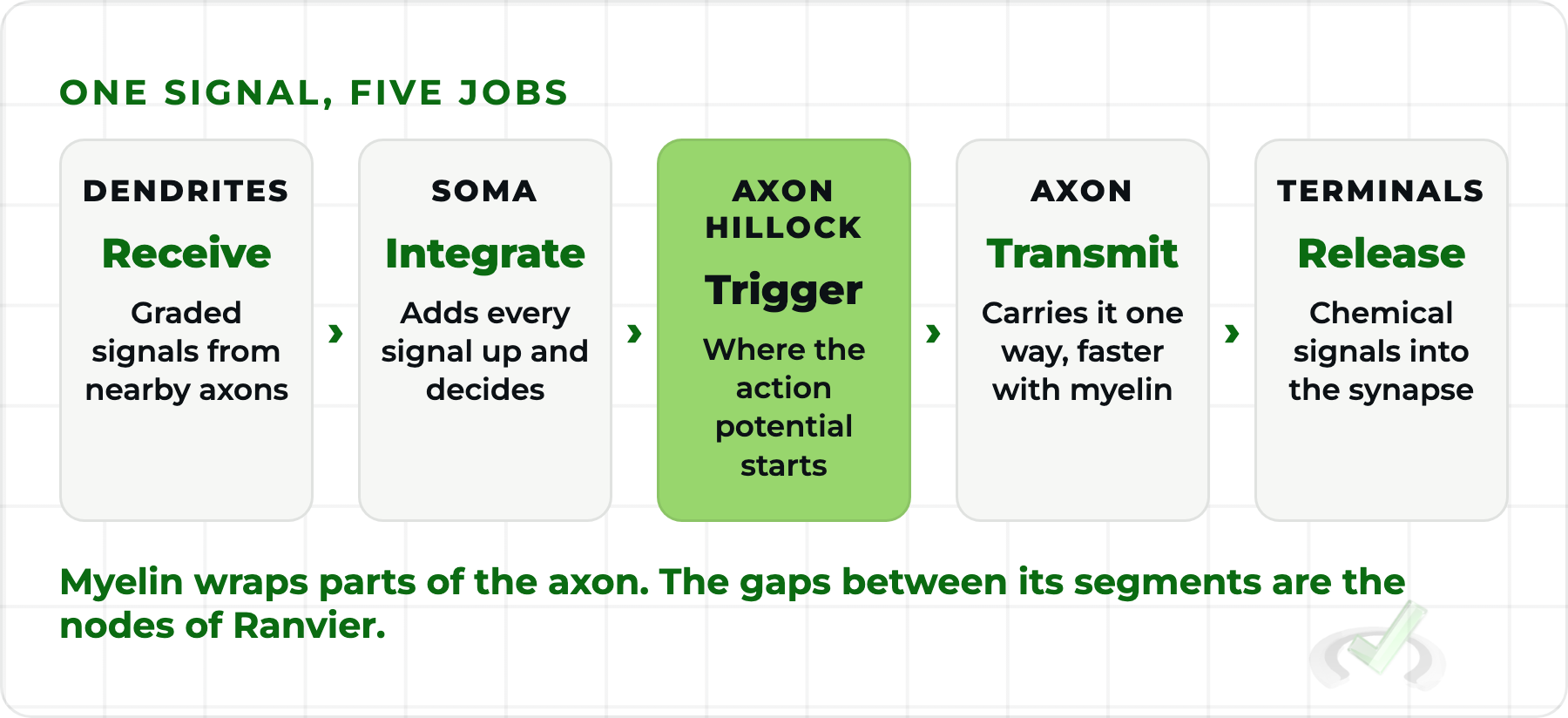
Dendrites receive. They sit in contact with the axons of nearby neurons. Those axons send signals, and the dendrites carry the signals to the cell body.
The soma integrates. Also called the cell body, it houses the nucleus and the organelles, so it makes proteins and handles the usual work of a cell, like metabolism. It also adds up every signal the dendrites bring in.
Those incoming signals are graded potentials. Some are excitatory and push the neuron toward firing. Others tell it to stand down. If enough excitatory signals arrive, the soma triggers an action potential.
The axon transmits. It carries the action potential, an electrical signal, over what can be a long distance, depending on how long the axon is. Dendrites receive, the soma integrates and the axon transmits. Easy to hold onto!
Myelin and conduction speed in the MCAT action potential
Myelin is a fatty covering around some axons, and it works as an electrical insulator. That raises the speed an action potential travels along the axon.
A common MCAT question compares a myelinated axon with an unmyelinated one. The only difference to expect is how fast each one conducts. Not every axon is myelinated, and that's normal.
Myelin is made by Schwann cells in the peripheral nervous system and by oligodendrocytes in the central nervous system. The gaps between myelin segments are the nodes of Ranvier, and the action potential jumps from node to node, which is called saltatory conduction.
Damage to myelin has serious effects. In multiple sclerosis, the immune system attacks myelin in the central nervous system, as the National Institute of Neurological Disorders and Stroke explains.
At the far end of the axon are the axon terminals, also called nerve endings. They house chemical signals. When the action potential arrives, those chemicals are released and bind to receptors on the dendrites of nearby neurons, and the cycle starts again.
For the cells behind this, such as Schwann cells and oligodendrocytes, see our study note on the cells of the nervous system.
Concentration Gradients and Where the Ions Sit
A concentration gradient is a difference in the amount of an ion between two places. In a neuron, that means the extracellular space, outside the cell, against the intracellular space, inside it.
Ions always want to move down their gradient, from high concentration to low, until the two sides even out, and that one idea explains a lot!
A cell with a lot of potassium inside will see potassium drift out. Much of the MCAT action potential comes down to these gradients.
Sarah remembers where the ions sit with a banana. Bananas are full of potassium, and so are neurons!
Potassium and organic anions are higher inside. Sodium and chloride are higher outside. Think of a neuron as a banana, packed with potassium.
Two kinds of channels come up next. Leaky channels are always open, so ions flow through them down their gradients. The more leaky channels a cell has for an ion, the more permeable it is to that ion.
Gated channels only open for a certain stimulus, a bit like needing a key. They matter a lot for the MCAT action potential.
If you'd like the transport side in depth, including pumps and channels, our study note on membrane transport lines up with this section.
Resting Membrane Potential: Why a Neuron Sits Near −70 mV
At rest, with no action potential underway, a neuron has a resting membrane potential of about −70 mV. The inside is more negative than the outside. Permeability and equilibrium potentials explain why the MCAT action potential starts from this value.
An ion's equilibrium potential is the membrane potential at which its concentration gradient is balanced by its electrical gradient. Sarah builds it up with potassium first, and it's easier than it sounds!
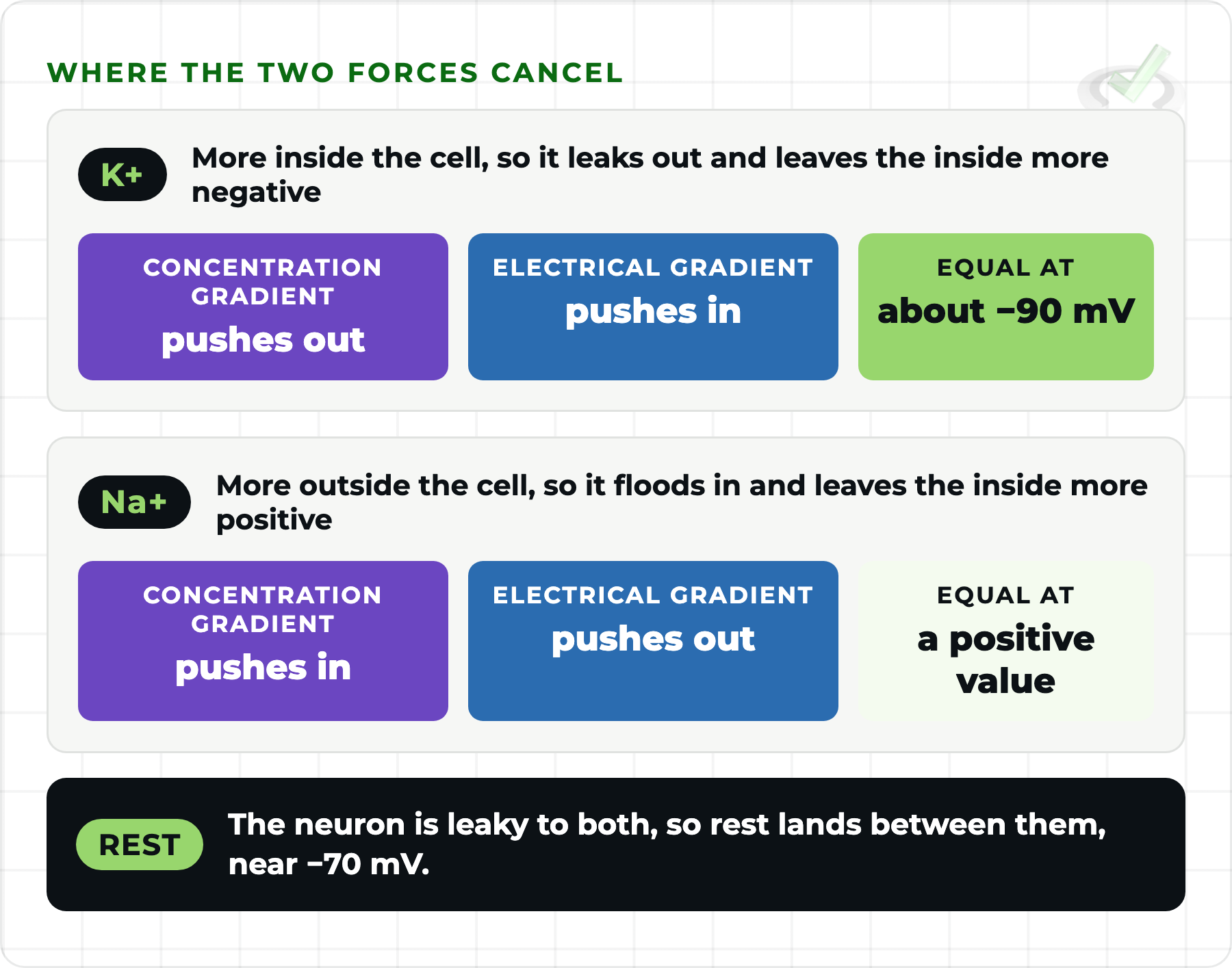
Potassium is higher inside, so its concentration gradient pushes it out. Each potassium that leaves takes a positive charge with it, and the inside gets more negative.
The electrical gradient then pulls the positive potassium back in. When the two pushes are equal, the membrane sits at potassium's equilibrium potential, about −90 mV.
Sodium runs the same logic in reverse. It's higher outside, so its concentration gradient pushes it in. Each sodium that enters carries a positive charge, so the inside gets more positive.
The electrical gradient now pushes sodium out. Where those two balance is sodium's equilibrium potential, and it's a positive value.
An equilibrium potential only becomes the resting potential if the cell is 100% permeable to that one ion. A neuron is permeable to potassium and sodium, and to a small degree chloride and a few others.
That's why rest, at −70 mV, isn't equal to either one. It works like a weighted average of the equilibrium potentials, with each ion weighted by how permeable the membrane is to it. Once that clicks, the rest gets easier!
Keep one fact from this section close for any MCAT action potential question. Sodium's equilibrium potential is positive and potassium's is negative. You'll use it for every step that follows.
The MCAT Action Potential Graph: Three Terms to Know
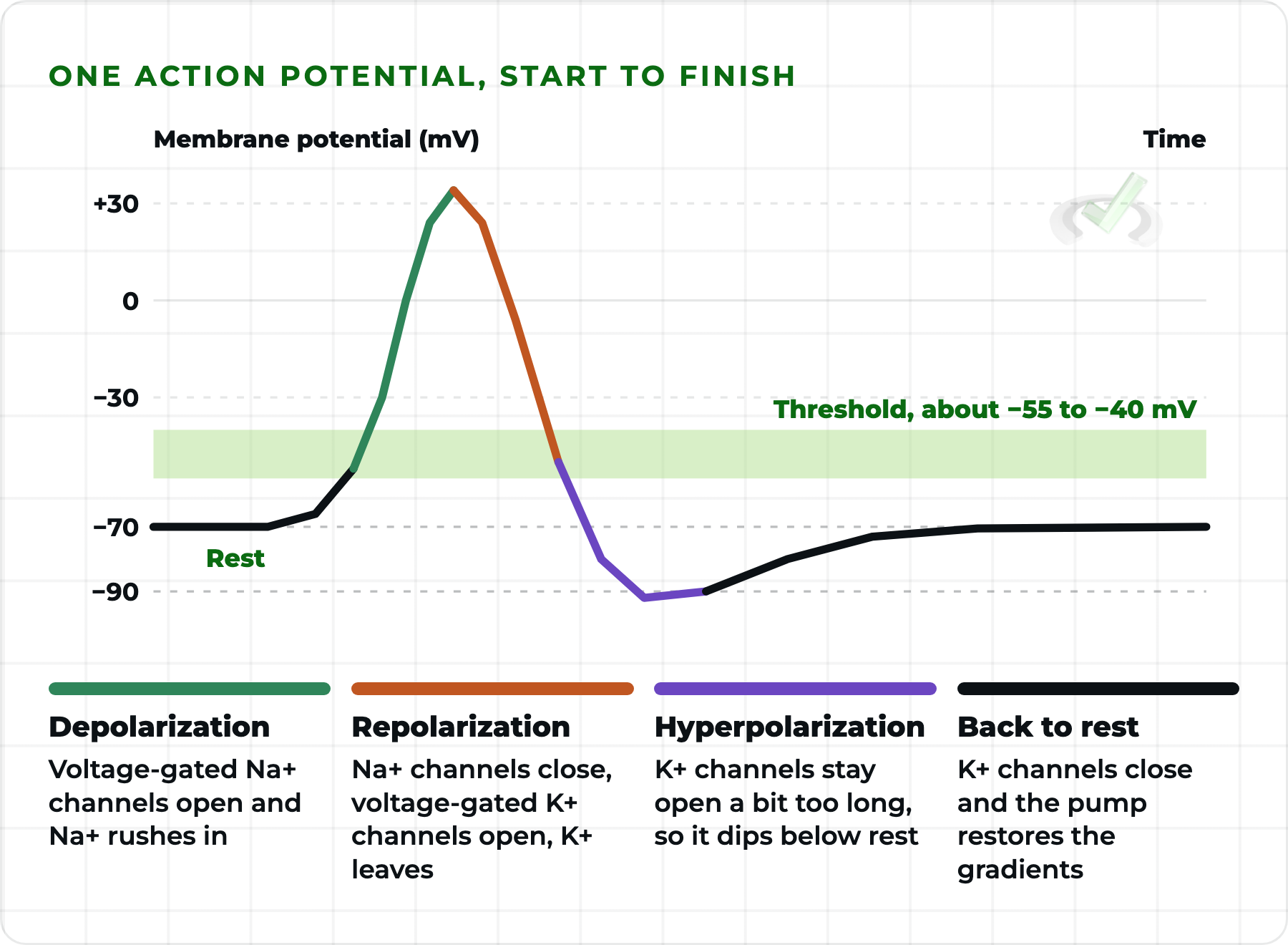
The graph below shows the shape passages draw for the MCAT action potential. Time runs left to right, and membrane potential runs up the side. It starts at the resting potential, near −70 mV.
Three terms describe what the curve is doing, and each one links to an ion you already know.
- Depolarization is the potential going from rest to more positive. That moves it closer to sodium's equilibrium potential, so permeability to sodium is increasing.
- Repolarization is the potential coming back down from the depolarized state. It's heading toward potassium's equilibrium potential, about −90 mV, so the neuron is more permeable to potassium.
- Hyperpolarization is any time the potential drops below the resting potential. The neuron is very permeable to potassium and sits close to −90 mV, before it settles back to rest.
Once you can read the curve, the ion for each phase follows from its direction on any MCAT action potential graph. Up means sodium. Down means potassium. You've got this!
Voltage-Gated Sodium Channels and Their Three States
Gated channels need a stimulus. The ones that matter most for an MCAT action potential, especially the sodium channels, are voltage-gated. They open once the membrane potential reaches a certain voltage, which is the threshold.
Voltage-gated sodium channels have three states, and the third is the unusual one.
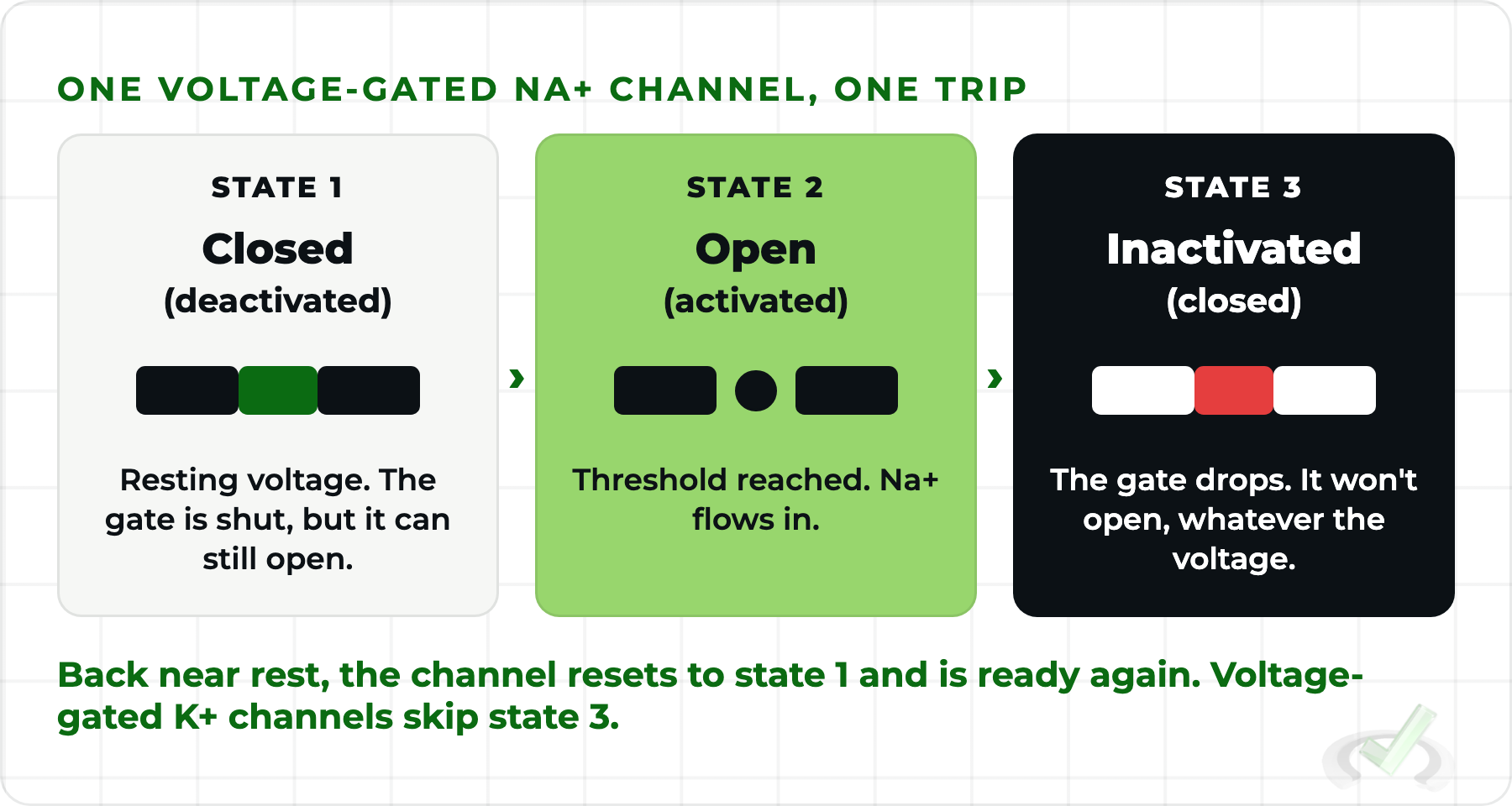
- Closed. At rest the channel is shut, so no sodium flows. It can still be opened by the right voltage.
- Open. The threshold voltage has been reached, and sodium moves into the cell.
- Inactivated. A second gate closes when the neuron has depolarized to a certain degree. The channel can't open again whatever the voltage does, until it resets.
The inactivated state belongs to the voltage-gated sodium channels :) Get comfortable with it early. Voltage-gated potassium channels don't have it.
It matters for two reasons. The inactivation gate stops sodium from pouring in and driving the potential up indefinitely, so it limits how long the action potential lasts. It also keeps the signal moving in one direction, which you'll see shortly.
Both states are shut. In a closed channel, the right voltage can still open it. In an inactivated channel, no voltage can. Sarah's deck calls state 1 “deactivated (closed)”. Whatever word a passage uses, ask whether the channel is shut but able to open, or shut and unable.
How an MCAT Action Potential Starts: Graded Potentials and Threshold
Dendrites collect signals from the axons of other neurons. Excitatory signals let in positively charged ions, so they depolarize the membrane and make firing more likely. Inhibitory signals let in negative ions, so they hyperpolarize the membrane and make firing less likely.
The cell body senses the total. If excitatory signals add up enough to bring the membrane to threshold, the neuron fires and the MCAT action potential begins.
Sarah uses −40 mV for threshold in the video, and plenty of textbooks teach about −55 mV. Threshold varies from neuron to neuron, usually somewhere from about −55 to −40 mV. If a passage gives you a number, use it.
Inhibition makes the climb longer. Suppose inhibitory signals have pushed the membrane down to −90 mV. To reach a threshold of −40 mV, it now has to rise 50 mV, where from −70 mV it would only need to rise 30 mV.
That's why inhibitory signals make an action potential less likely.
Signals add up in two ways. They sum over time, which is temporal summation, and over space, which is spatial summation. Either way, the soma is working out whether the total reaches threshold.
Once threshold is reached, the action potential starts at the axon hillock, the connection point between the cell body and the axon. From there it travels down the axon toward the terminals, and it only travels in one direction.
It never goes back and forth. That one-way rule shows up on the exam!
Passages like to invent a threshold or a resting value and ask what happens next, so practicing on passages helps this reasoning stick.
In our 6-Week Live MCAT Accelerator, we work AAMC-style passages together in every class. Sarah teaches our December cohort, and the course page shows the dates.
Depolarization, Repolarization and Hyperpolarization, Step by Step
The whole sequence runs in this order, and each step follows from the one before it.
- Threshold is reached. The voltage-gated sodium channels activate and open.
- Depolarization. Sodium flows in and the membrane potential rises toward sodium's equilibrium potential.
- Repolarization. The sodium channels close and the voltage-gated potassium channels open. Potassium leaves and the potential falls. Each piece follows from the last!
- Hyperpolarization. The potassium channels stay open a little too long, so the potential dips below rest, toward −90 mV.
- Reset. The potassium channels close, the sodium channels leave the inactivated state, and the pump restores the gradients.
Depolarization in the MCAT action potential
At threshold, voltage-gated sodium channels activate and sodium flows into the cell. It wants in for two reasons. It's more concentrated outside, and the inside of the cell is negative while sodium is a cation. Both forces drive it in.
So whenever you see depolarization, think of open voltage-gated sodium channels and a membrane that's more permeable to sodium.
The signal spreads like a row of dominoes. The channels nearest the axon hillock open first and depolarize their patch of membrane. The next patch senses that, reaches its own threshold and fires, and so on down the axon.
Behind the wave, the sodium channels become inactivated. That's the reason the signal can't travel backward.
Repolarization in the MCAT action potential
Repolarization brings the cell back toward its resting potential. Without it, the neuron couldn't fire again, and it needs to fire again to signal how intense a stimulus is.
Fewer sodium channels are active now, because more of them have closed. Voltage-gated potassium channels open, a little later than the sodium channels did.
Potassium is more concentrated inside, so it flows out and takes its positive charge with it. The inside becomes more negative with every potassium that leaves, and the potential falls.
Hyperpolarization in the MCAT action potential
Hyperpolarization happens because the voltage-gated potassium channels stay open longer than they'd need to for the potential to just return to rest. The cell stays very permeable to potassium, so it drifts toward potassium's equilibrium potential, about −90 mV.
It can look like a mistake, but it has a purpose. The dip makes it harder to fire again right away. If a neuron still fires action potentials in quick succession, the stimulus must be very intense, because it's overcoming that dip.
Refractory Periods: Absolute vs Relative
The refractory period is the stretch after an MCAT action potential when firing another one is blocked or harder. Think of it as a cool-down. There are two types, and they have different causes.
Sarah's numbers make the relative period concrete. From rest, a neuron needs about 30 mV of extra depolarization to reach a threshold of −40 mV. From −90 mV during hyperpolarization, it needs about 50 mV.
Absolute comes from inactivated sodium channels. Relative comes from hyperpolarization. Know which is which, because passages test the cause and the effect. You'll be glad you did :)
The Sodium-Potassium Pump Resets the Gradients
The sodium-potassium pump gets the neuron back to baseline after each MCAT action potential. It pumps sodium out and potassium in, spending ATP to move both against their gradients. That keeps sodium more concentrated outside and potassium more concentrated inside.
Remember that potassium left the cell during repolarization. Too much of that would change the concentration gradient, so the pump restores it before the next action potential.
Without those gradients, the neuron couldn't produce another MCAT action potential, because every step above depends on them. That's the link between this pump and everything else on this page, and it's a satisfying one!
All or Nothing: How Neurons Signal Intensity
The MCAT action potential is all or none. It either happens or it doesn't, and there aren't strong ones and weak ones. Every MCAT action potential in a neuron is the same size, which makes elimination easy!
So how does a neuron tell the brain that one stimulus is stronger than another? By frequency. A very intense stimulus produces action potentials in rapid succession, and a calm one produces them less often.
Two feedback loops explain why the size doesn't change. Opening voltage-gated sodium channels depolarizes the membrane, which opens more of them, so each action potential drives itself once it starts. Potassium channels then act as the negative feedback that pulls the membrane back down.
Synaptic Transmission: From an Electrical Signal to a Chemical One
Why do all these steps matter? Because of what happens when the MCAT action potential reaches the end of the axon.
There's a small gap there, the synapse, between the axon and the receiving dendrite. An electrical signal can't cross it, so a chemical messenger has to.
- The action potential reaches the axon terminal and depolarizes it, which activates voltage-gated calcium channels.
- Calcium rushes into the cell and triggers exocytosis of the synaptic vesicles that hold the neurotransmitter. More calcium means more neurotransmitter released.
- The neurotransmitter diffuses across the synapse and binds to ligand-gated channels on the receiving neuron's dendrite. The neurotransmitter is the ligand.
- Depending on the neurotransmitter and the channel, positive or negative ions flow in. Positive ions depolarize the membrane, which is excitatory. Negative ions hyperpolarize it, which is inhibitory.
Those excitatory and inhibitory effects are the graded potentials the receiving neuron adds up, and that brings you back to the start of this page. The neuron then decides whether to fire an action potential of its own.
The neurotransmitter doesn't hang around in the synapse. It's cleared by reuptake, by enzymes that break it down, or by diffusing away.
For a wider look at how neurons talk to each other, see our study note on neuronal communication, and the action potential propagation note for the textbook version of this topic.
Try a Two-Part MCAT Action Potential Question
Here's a question that joins two sections of this page. Feel free to pick your answer before you open the explanation.
A neurotransmitter opens ligand-gated Cl− channels on a typical neuron's dendrite. What happens next?
- Cl− flows out, and the neuron becomes more likely to fire.
- Cl− flows in, and the neuron becomes less likely to fire.
- Cl− flows in, and the membrane depolarizes to threshold.
- Cl− flows out, and voltage-gated Na+ channels open.
Show the answer
B is correct.
Part 1, the concentration gradient. Chloride is higher outside the cell, and in a typical neuron it flows in.
Part 2, graded potentials. Negative charge flowing in hyperpolarizes the membrane, so firing becomes less likely. Choices A, C and D each get a direction or an effect wrong.
That's the habit to build for every MCAT action potential question. Take the gradient first, then ask what the charge does to the membrane. Reasoning in two short steps works on questions you've never seen before!
Common Traps on MCAT Action Potential Questions
These are the mix-ups that cost points on an MCAT action potential question. Check your answer against each one before you commit.
- Stronger or weaker action potentials. They don't exist. Intensity is frequency.
- Closed vs inactivated. An inactivated sodium channel can't open at any voltage. A closed one can.
- Resting potential vs potassium's equilibrium potential. About −70 mV against about −90 mV, and the gap comes from sodium permeability.
- Absolute vs relative refractory periods. Inactivated channels cause the first. Hyperpolarization causes the second.
- One threshold number. Threshold varies, usually about −55 to −40 mV. Trust the passage.
- Myelin and strength. Myelin raises speed only.
Our guides on how to prepare for the Biology MCAT and how to review the Biology section show where this topic fits in your Biology prep. You can also check the MCAT action potential against the AAMC content outline or our AAMC outline checklist.
MCAT Action Potential FAQ
What is the resting membrane potential of a neuron?
It's about −70 mV, with the inside of the cell more negative than the outside.
What is the threshold for an MCAT action potential?
Threshold varies from neuron to neuron, usually somewhere from about −55 to −40 mV. Sarah uses −40 mV in her video. Use whatever value a passage gives you.
Why is the MCAT action potential all or none?
Once threshold is reached, the voltage-gated sodium channels open in a feedback loop that makes every action potential the same size. Neurons signal intensity by how often they fire.
What's the difference between the absolute and relative refractory periods?
During the absolute period, sodium channels are inactivated, so no stimulus can start an action potential. During the relative period, the neuron is hyperpolarized and needs a bigger stimulus.
Start with where the ions sit, ask which way each one wants to move, and the steps rebuild themselves. The more passages you work this way, the faster it gets!
Sarah's free cheat sheet puts every step on five pages, so you can keep it beside your practice passages :)
Free download. Sarah's action potentials cheat sheet, every step on five pages.
On its way.
Check your inbox in the next minute.
If you'd like a teacher beside you, Sarah leads our December cohort of the 6-Week Live MCAT Accelerator. You get 12 live classes with a 520+ scorer, and your seat includes seven 1:1 sessions with a 515+ scorer.
If the cohort dates don't line up with your test date, 1:1 MCAT tutoring starts whenever you do.





 To help you achieve your goal MCAT score, we take turns hosting these