If you've ever opened an orgo review and found a wall of arrows, you're in good company!
This list of MCAT organic chemistry reactions covers all 31 the AAMC names. They're grouped by the functional group you'll see in a passage, with a line on how to spot each one and what to remember 🙂
Each reaction links to the study note that teaches it in depth. You can also grab the whole list as a printable PDF to keep beside your notes!
Free printable PDF
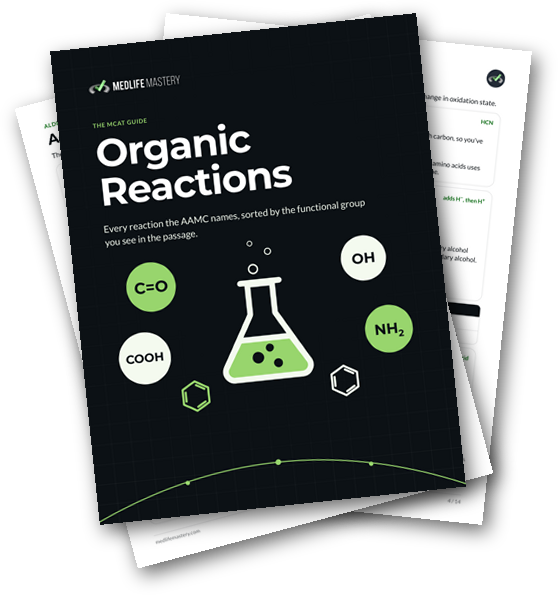
Every orgo reaction you need for a 130+ in Chem/Phys, in one printable PDF
All 31 reactions the AAMC names, drawn out with how to spot each one. Print it and keep it beside your notes!
On its way.
Check your inbox in the next minute.
Which Organic Chemistry Reactions Are on the MCAT?
The AAMC lists the MCAT organic chemistry reactions in its content outline, and it sorts them by functional group. Aldehydes and ketones come first, then alcohols, carboxylic acids, acid derivatives, phenols, and the reactions of amino acids, lipids and sugars.
Our full AAMC outline checklist links every bullet to a study note!
Counted reaction by reaction, the outline gives you 31 MCAT organic chemistry reactions.
Orgo shows up in both Chem/Phys and Bio/Biochem, almost always in a passage, so you'll meet these reactions next to an experiment or a biological pathway far more often than on their own.
Sort every reaction by the functional group it starts from. When a passage shows you a molecule, the functional group is the first thing you'll recognize, and it tells you which handful of reactions are possible!
How to Read Any MCAT Organic Chemistry Reaction
Most of the MCAT organic chemistry reactions on this list are one move in different costumes! Something rich in electrons attacks a carbon that's short on them. Three questions get you to the product, even for a molecule you've never seen!
- Where's the electron-poor carbon? Oxygen pulls electrons away from the carbon it's bonded to, so the C=O carbon carries a partial positive charge. That's your target!
- What's coming in? Look for a lone pair or a negative charge. On this list, it's an alcohol, an amine, a hydride, cyanide or an enolate.
- Can anything leave? Your answer tells you which product to expect!
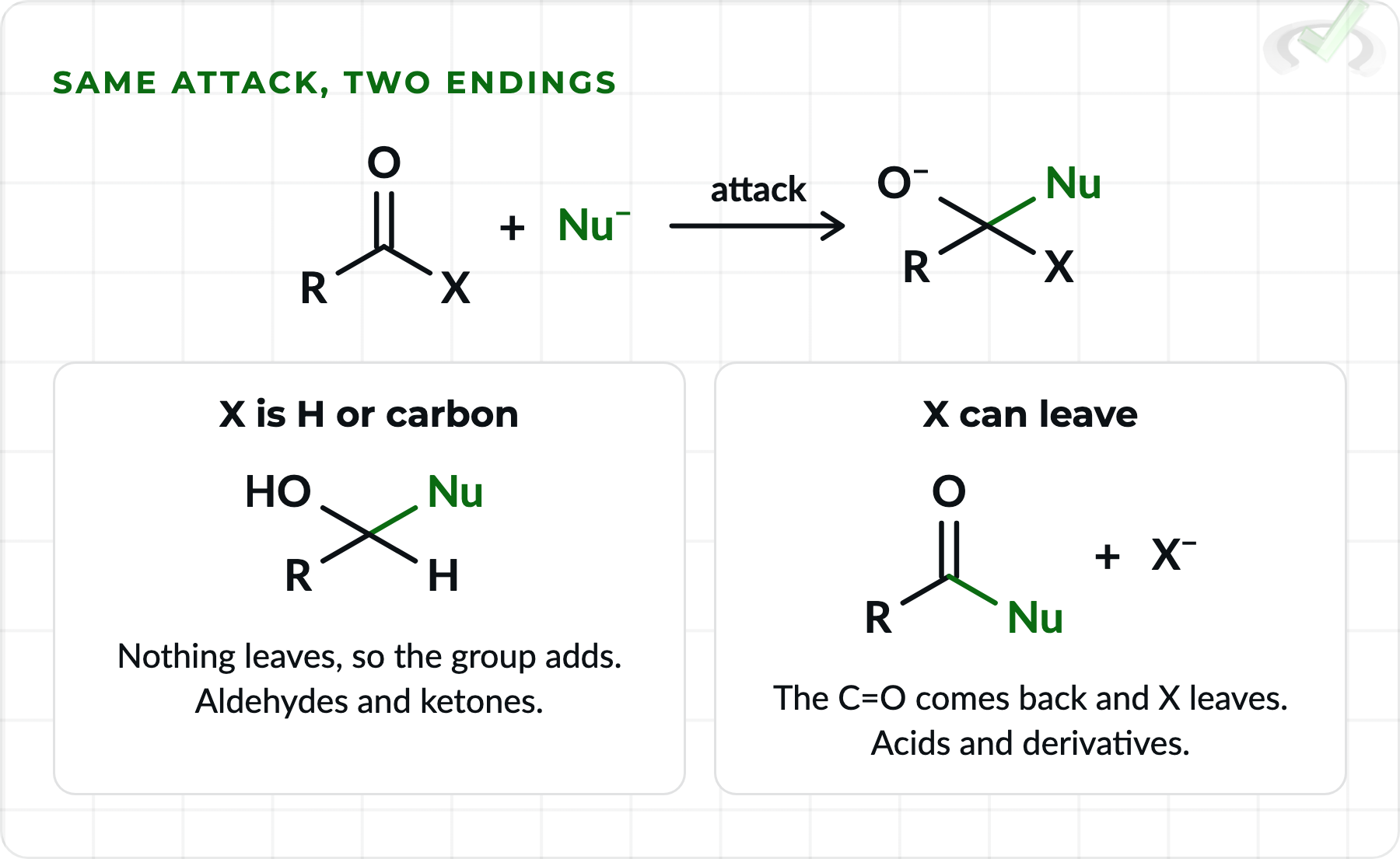
An incoming group stays on an aldehyde or ketone and replaces the leaving group on an acid derivative.
Reading reactions in a passage gets easier with reps!
In our 6-Week Live MCAT Accelerator, we work AAMC-style passages together in every class, and your seat includes 7 one-on-one sessions with a 515+ scorer if you'd like someone to walk through the orgo ones with you.
Aldehyde and Ketone Reactions
Ten of the 31 MCAT organic chemistry reactions start from an aldehyde or ketone! The H and carbon groups on these carbons can't leave, so whatever attacks them stays on. The aldehydes and ketones chapter covers each one in more depth.
1Hemiacetal and hemiketal
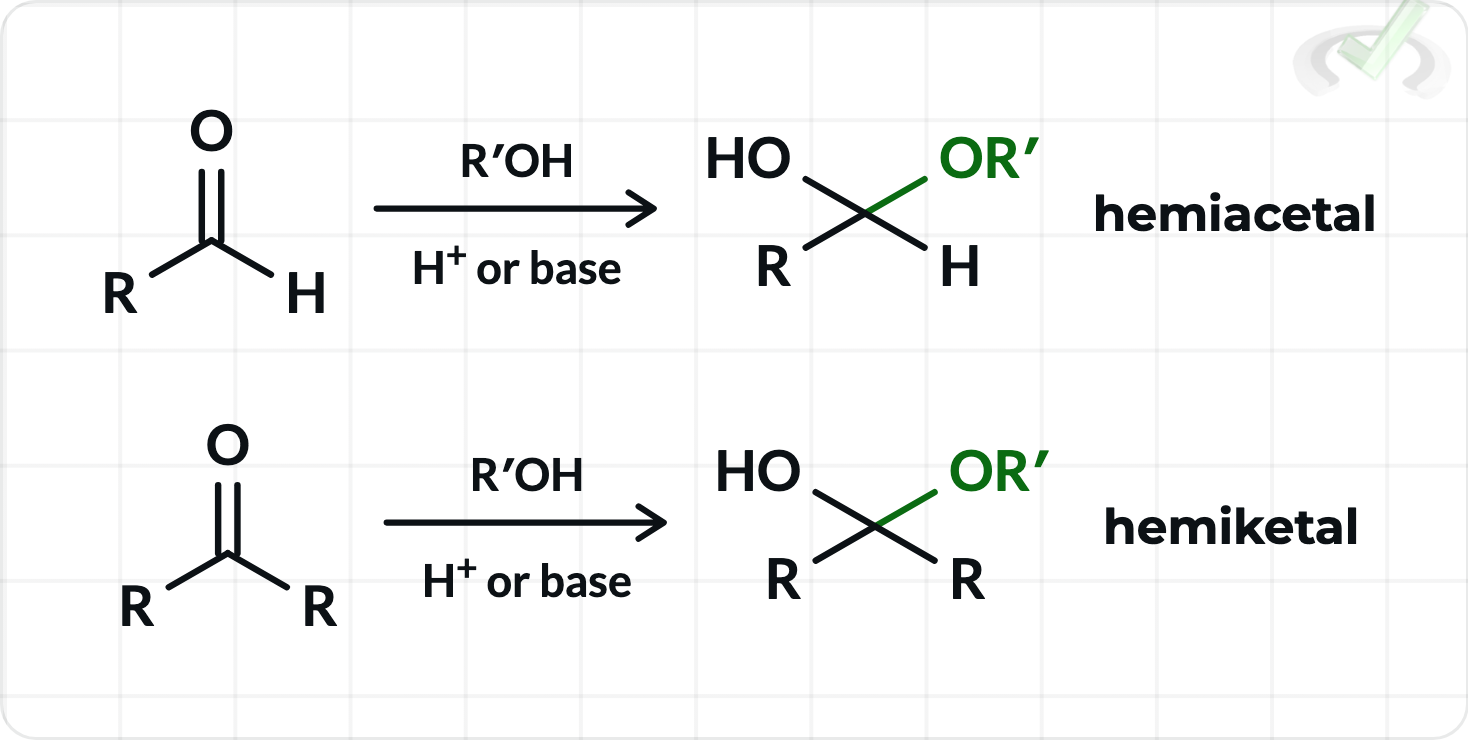
One alcohol adds to the C=O, with acid or base. The carbon ends up holding an OH and an OR. An aldehyde gives a hemiacetal and a ketone gives a hemiketal. Glucose closes into a ring this way! See nucleophilic addition reactions.
2Acetal and ketal
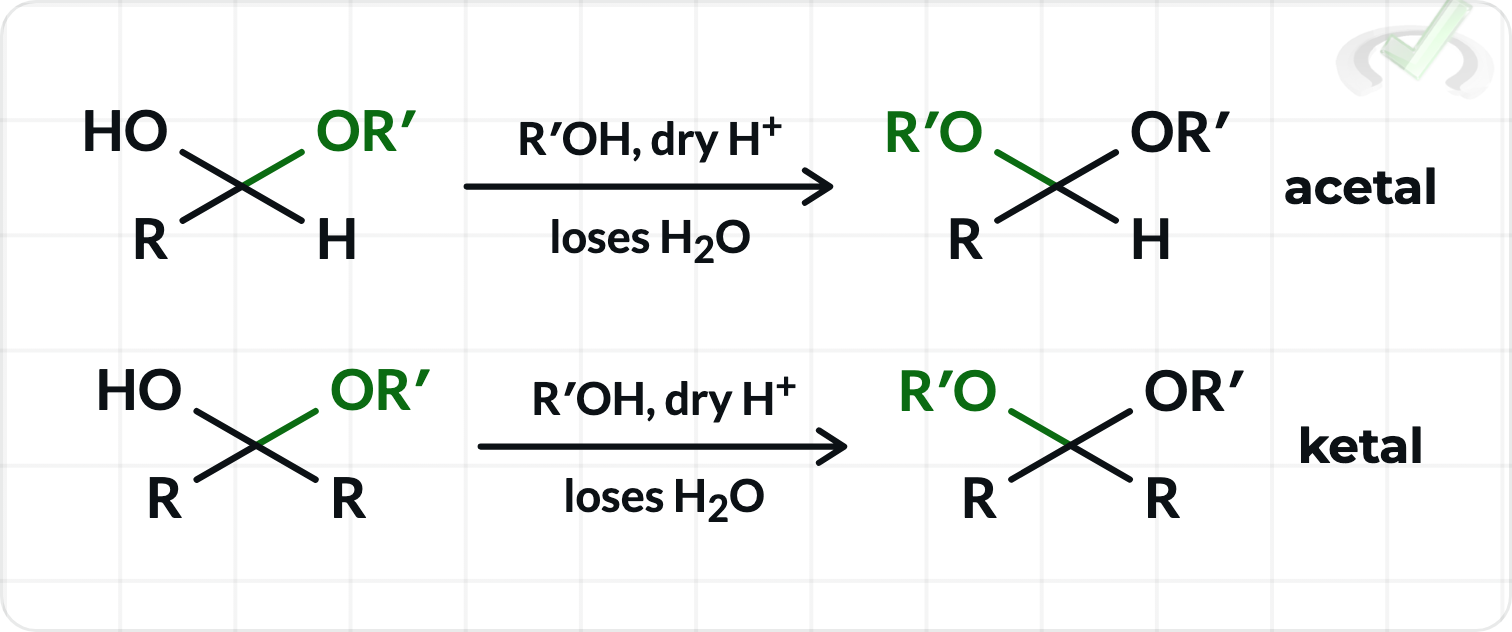
A second alcohol adds in dry acid and water leaves, so the carbon holds two OR groups. A hydrogen on that carbon makes it an acetal, and two R groups make it a ketal. Acetals resist base and hydride, so they protect a C=O, and aqueous acid brings it back.
3Imine and enamine
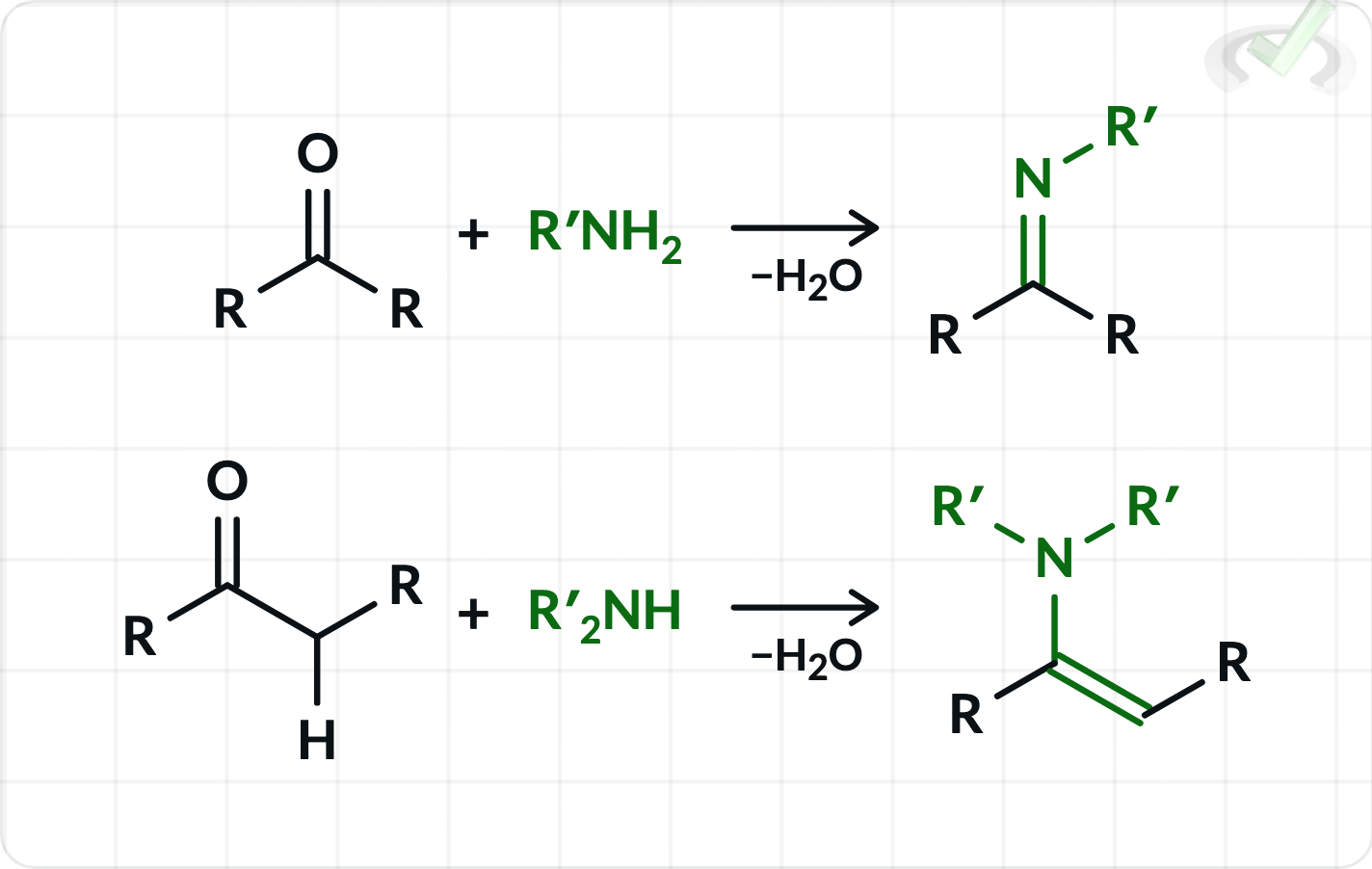
A primary amine or ammonia gives an imine, a C=N. A secondary amine has no second N-H to lose, so it gives an enamine, a C=C with nitrogen on it. An imine with an α-H can tautomerize to an enamine, and the imine is favored.
4Cyanohydrin
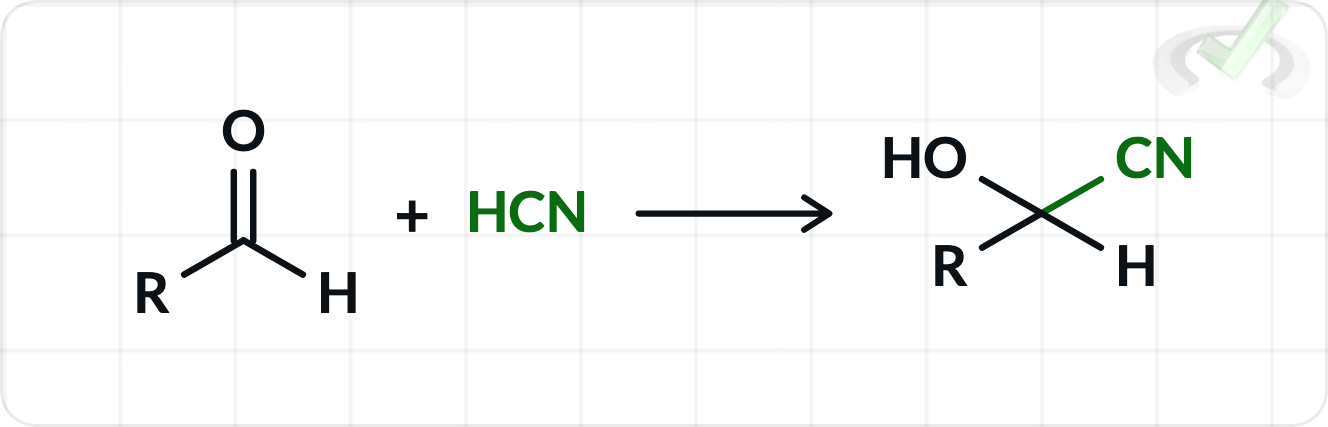
Cyanide attacks the C=O through carbon, so you've built a new C-C bond, and the product carries an OH and a C≡N on one carbon!
5Hydride reduction
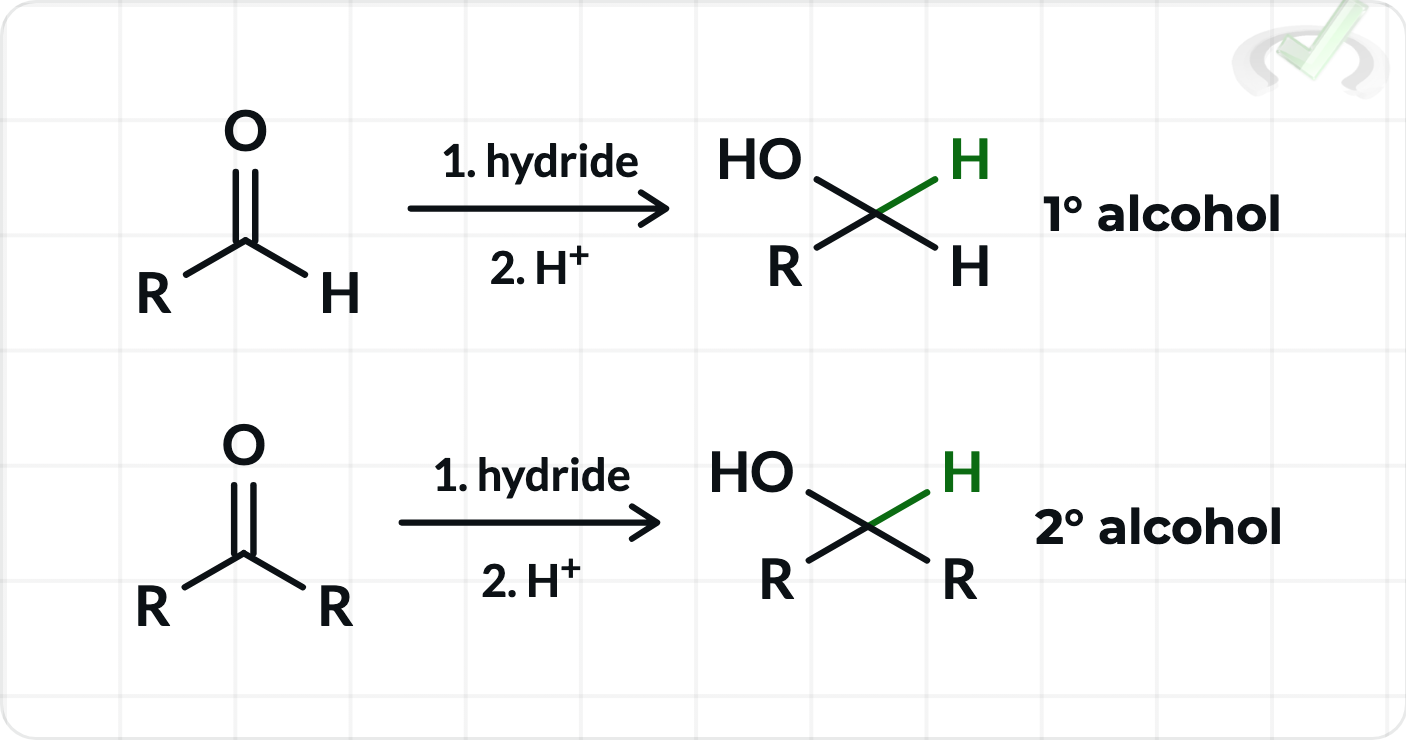
NaBH4 or LiAlH4 adds a hydride, then a proton. An aldehyde reduces to a primary alcohol and a ketone reduces to a secondary alcohol. See redox reactions of aldehydes and ketones.
6Oxidation of aldehydes
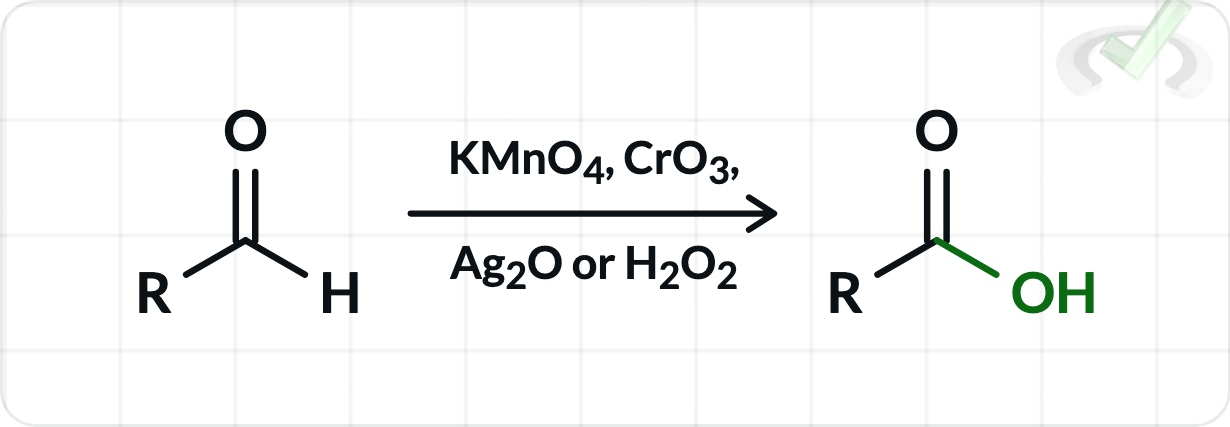
KMnO4, CrO3, Ag2O or H2O2 turns an aldehyde into a carboxylic acid. PCC is too weak to go past the aldehyde, and a ketone has no C-H on that carbon to oxidize.
7Keto-enol tautomerism
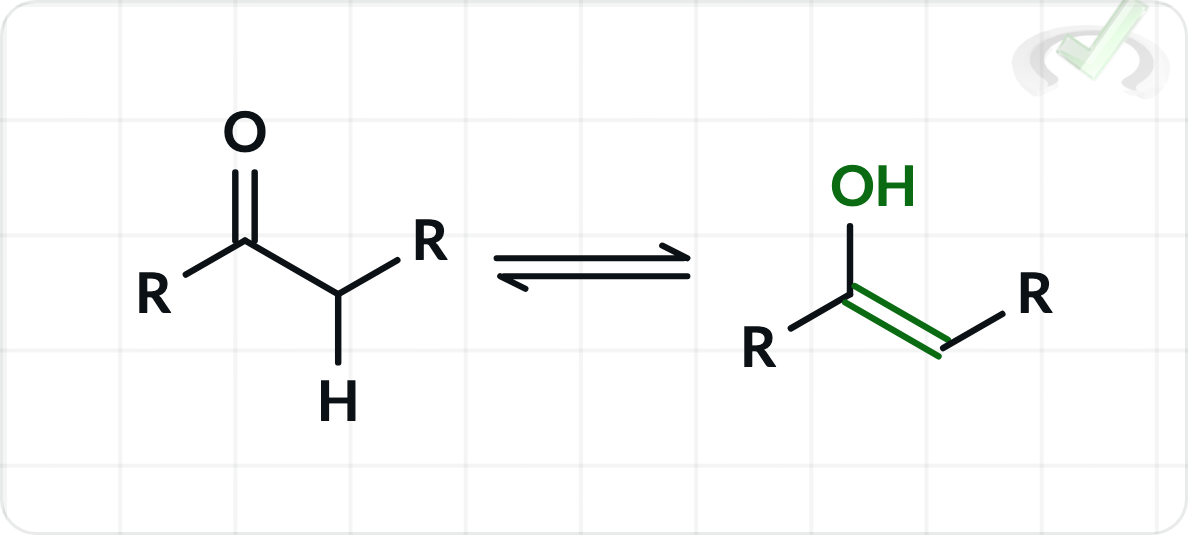
Acid or base moves a hydrogen and a double bond, and the keto form is strongly favored. A chiral α-carbon that carries a hydrogen racemizes through the flat enol. See keto-enol tautomerization.
8Kinetic and thermodynamic enolates
A strong base pulls off an α-H. The table sorts which enolate wins!
9Aldol addition and condensation
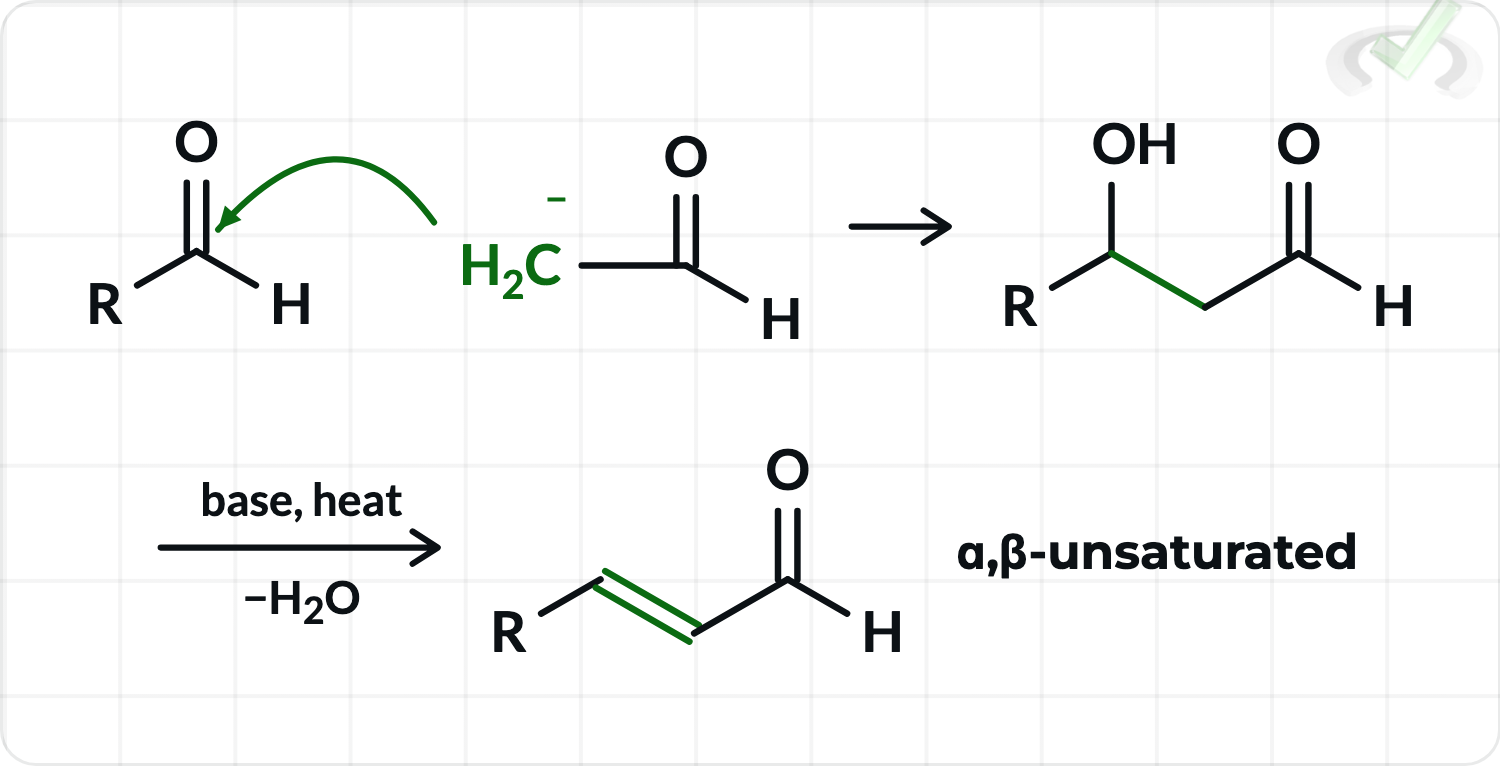
The enolate of one carbonyl attacks the C=O of another and joins the α-carbon to the carbonyl carbon. Heat with base drives off water to give an α,β-unsaturated carbonyl. See aldol addition and condensation.
10Retro-aldol
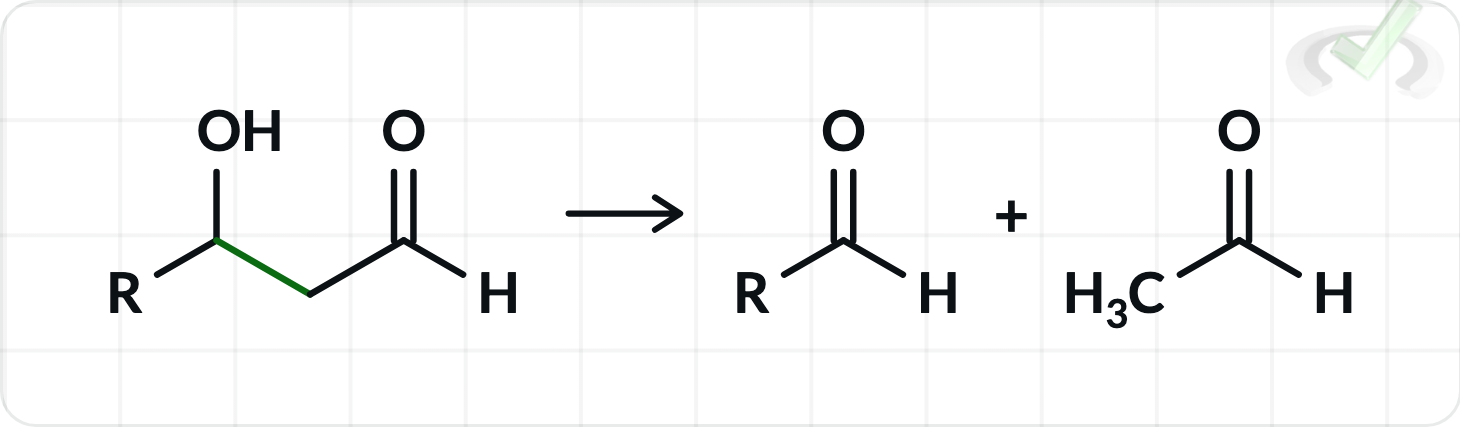
Aqueous base and heat break the bond between the α and β carbons. Aldolase splits fructose 1,6-bisphosphate this way in glycolysis!
Print this list
Keep all 31 reactions beside your notes
The free PDF draws every reaction on this page across 14 printable pages. Keep it next to you during practice passages!
On its way.
Check your inbox in the next minute.
Alcohol and Phenol Reactions
Five reactions on the outline start from an alcohol or a phenol. The OH can be oxidized, swapped out once it's turned into a better leaving group, or covered up while the rest of the molecule reacts.
These are the MCAT organic chemistry reactions where SN1 and SN2 show up!
11Oxidation of alcohols
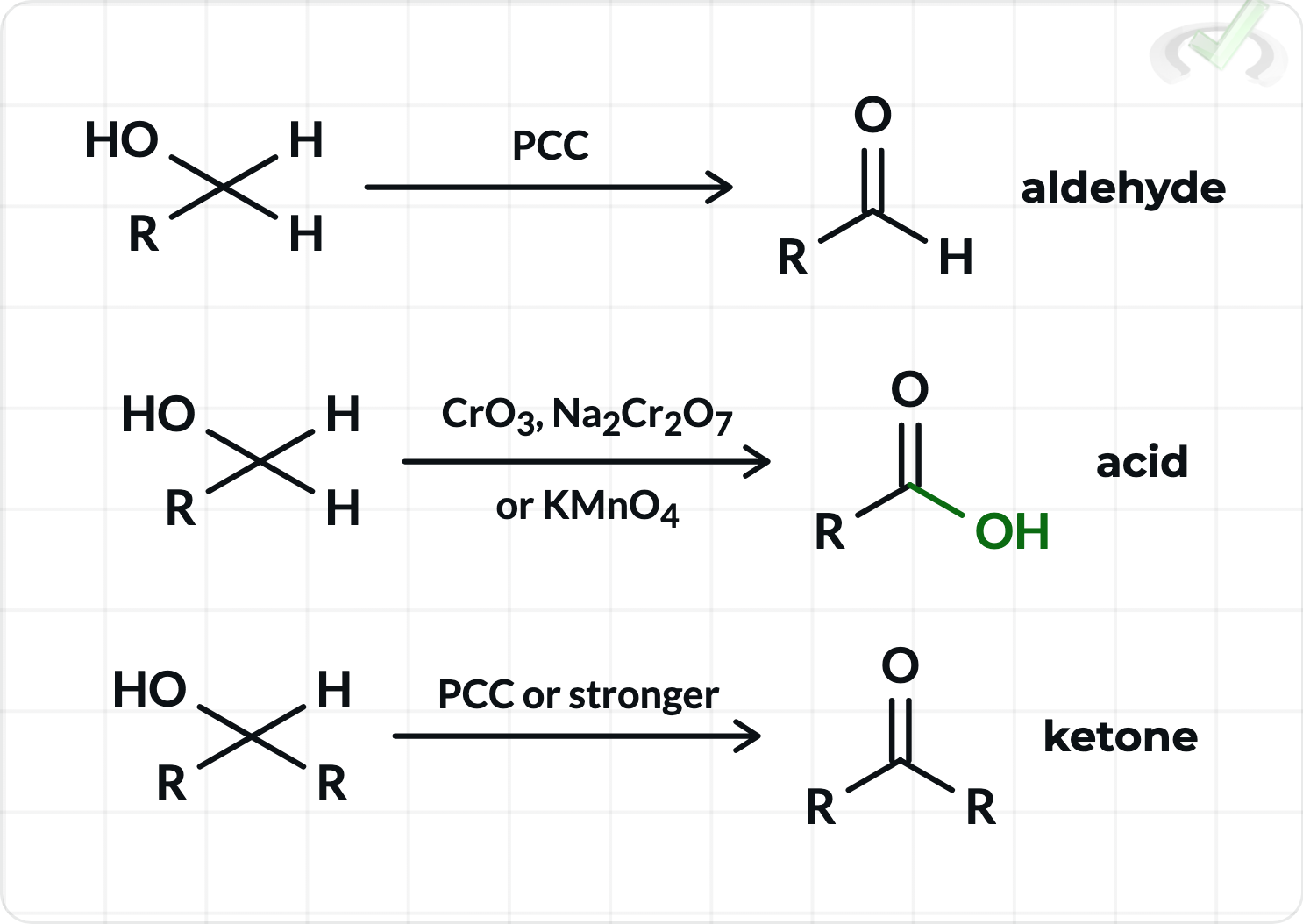
PCC takes a primary alcohol to an aldehyde and stops there, because it's anhydrous. CrO3, Na2Cr2O7 or KMnO4 take it all the way to a carboxylic acid. A secondary alcohol gives a ketone, and a tertiary alcohol doesn't oxidize. See redox reactions of alcohols.
12SN1 and SN2
A nucleophile replaces a leaving group on a tetrahedral (sp3) carbon. The table compares the two, and SN2 and SN1 reactions goes deeper.
13Mesylates and tosylates
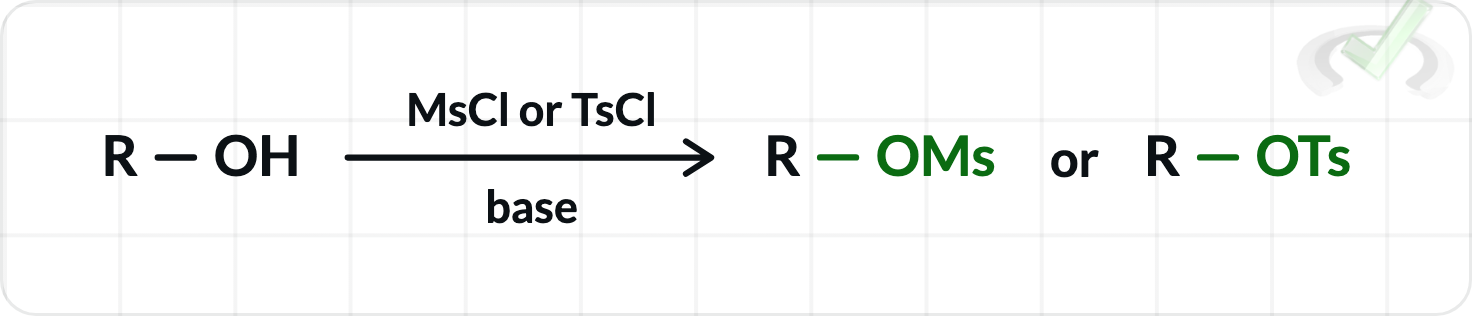
Hydroxide leaves poorly. Converting the OH to a mesylate or tosylate gives a weak base that leaves easily, and these groups also shield the alcohol from oxidants.
14Protecting an alcohol
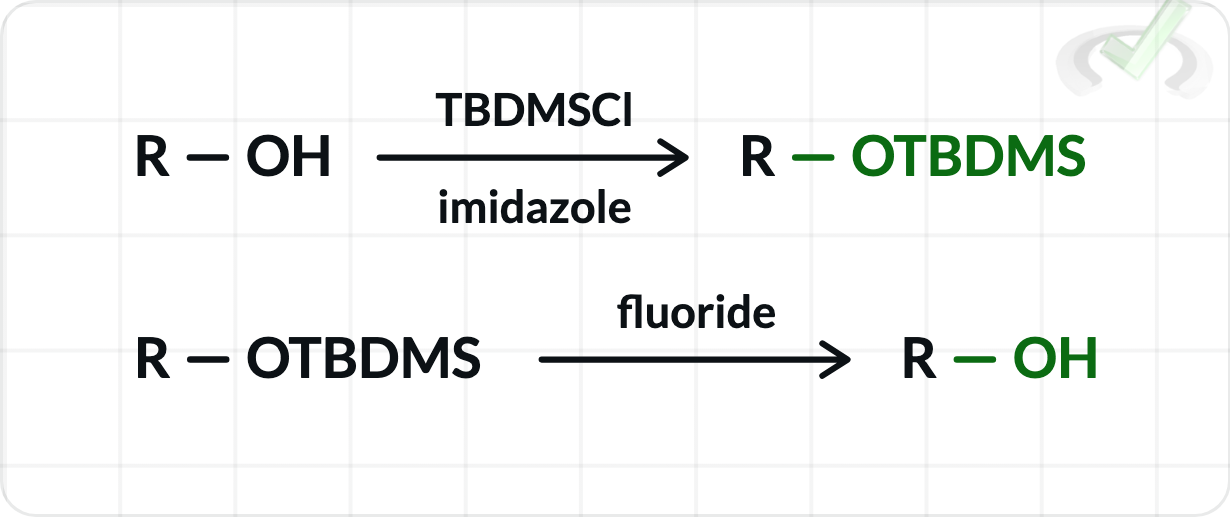
A silyl group such as TBDMS covers the OH so a strong base or nucleophile can react elsewhere, and fluoride takes it off at the end! See protection reactions of alcohols.
15Hydroquinone and quinone
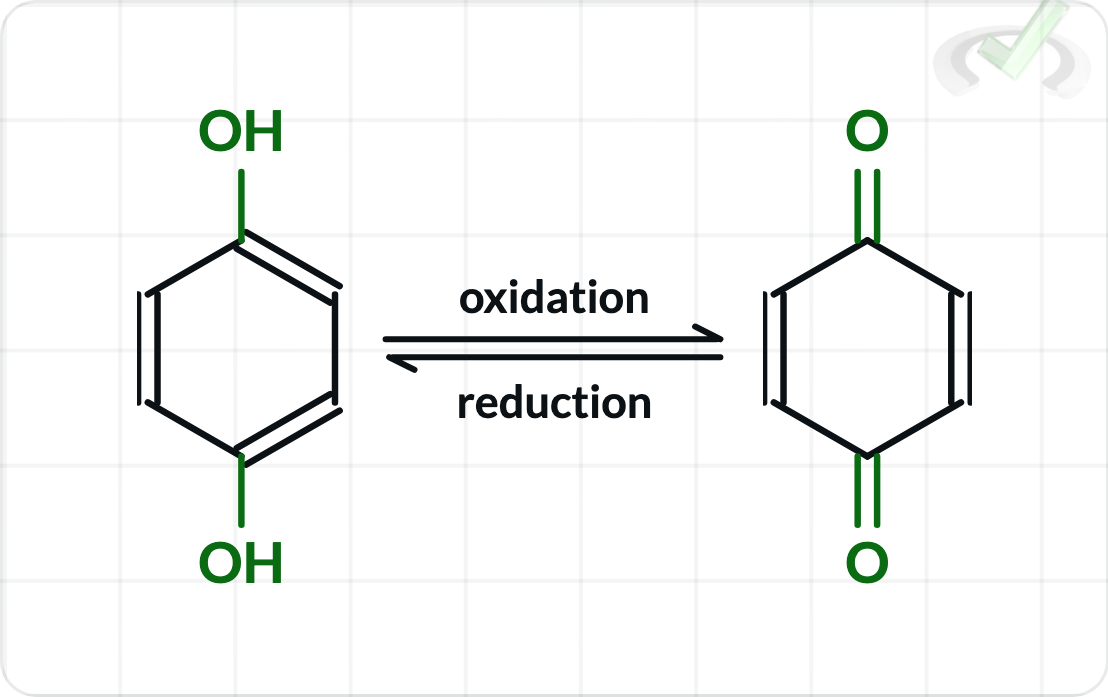
A hydroquinone oxidizes to a quinone by losing two electrons and two protons. Ubiquinone (coenzyme Q) carries electrons in the electron transport chain this way! See redox reactions of phenols.
Carboxylic Acid Reactions
The OH on a carboxylic acid can leave, so most of these MCAT organic chemistry reactions swap it for something else. The carboxylic acids chapter has the full set of notes!
16Amide and lactam formation
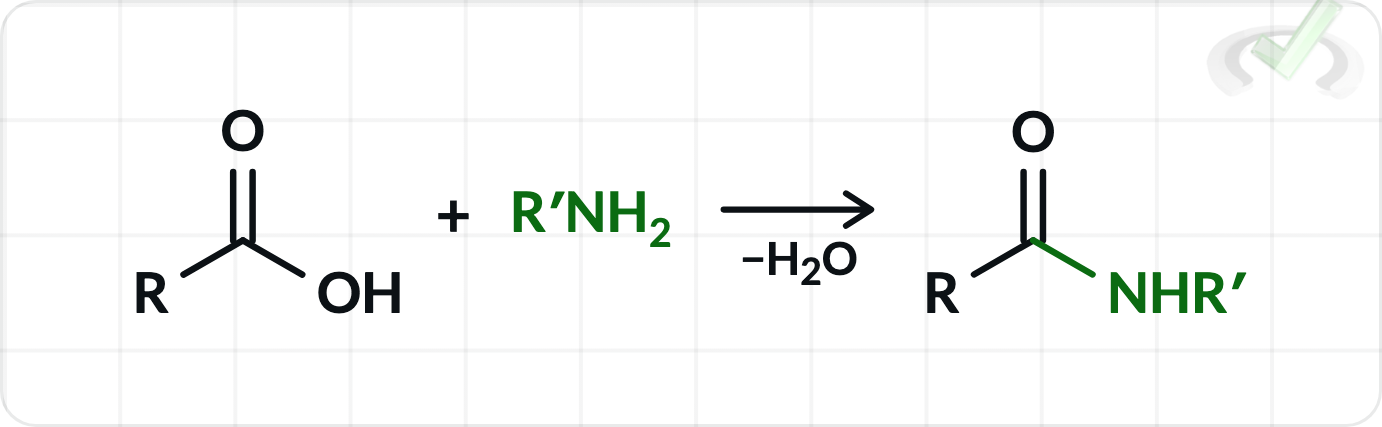
An amine attacks the C=O and water leaves, giving an amide. A cyclic amide is a lactam, and a peptide bond is an amide. See nucleophilic substitution reactions of carboxylic acids.
17Ester and lactone formation
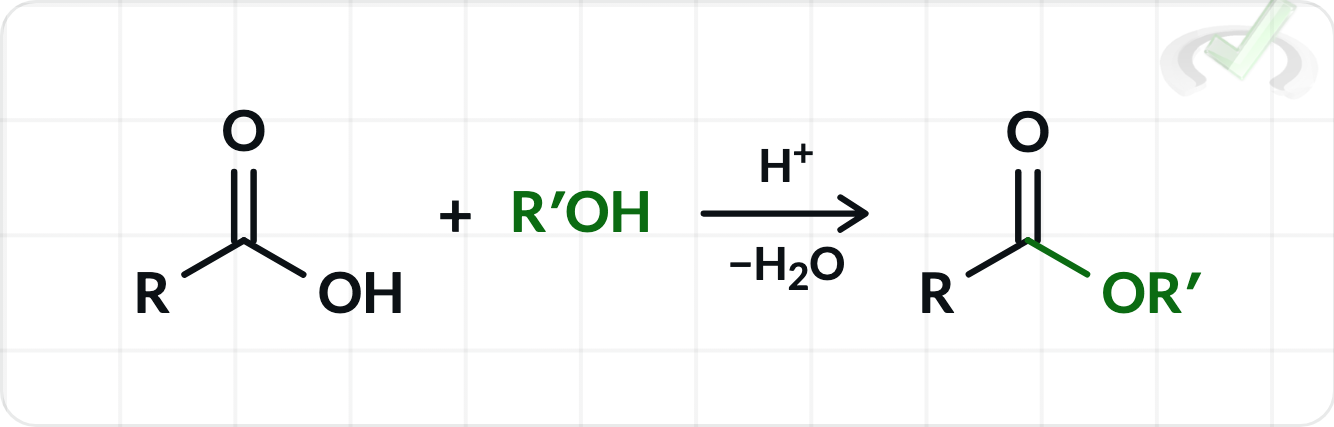
An alcohol attacks in acid, which protonates the C=O oxygen and makes the carbon a better target. A cyclic ester is a lactone.
18Anhydride formation
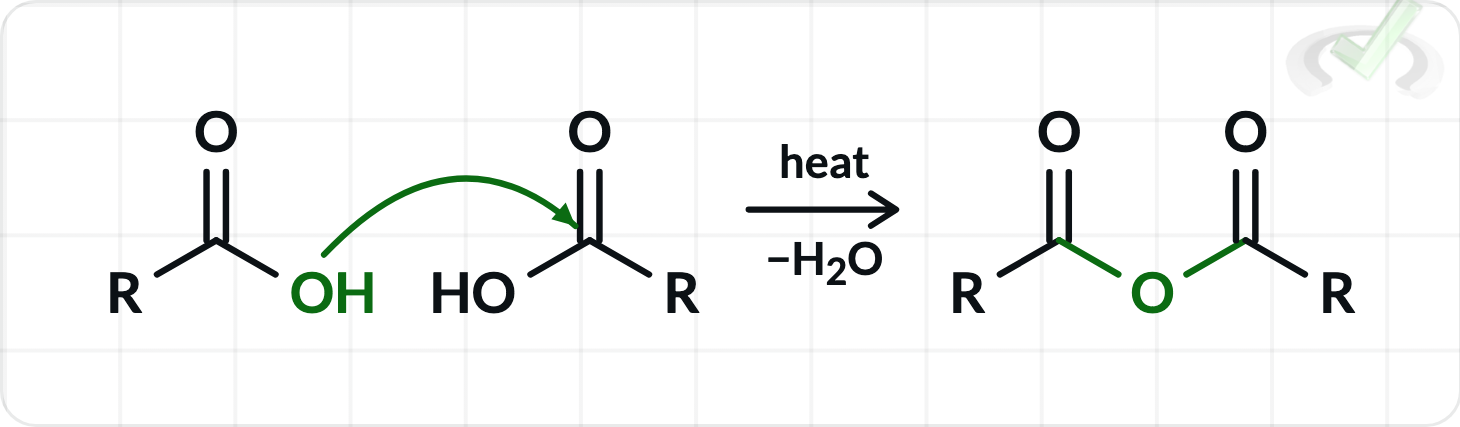
One acid's OH attacks another acid's C=O, and water leaves. Two acyl groups end up sharing one oxygen!
19Reduction
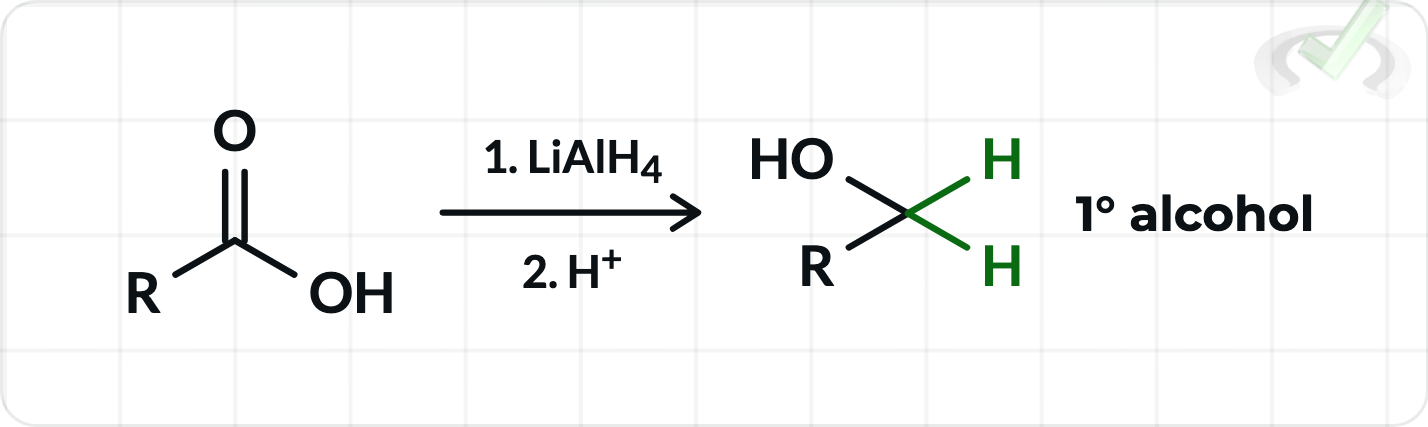
LiAlH4 reduces a carboxylic acid to a primary alcohol, and NaBH4 is too weak for it. An aldehyde forms on the way and gets reduced too.
20Decarboxylation
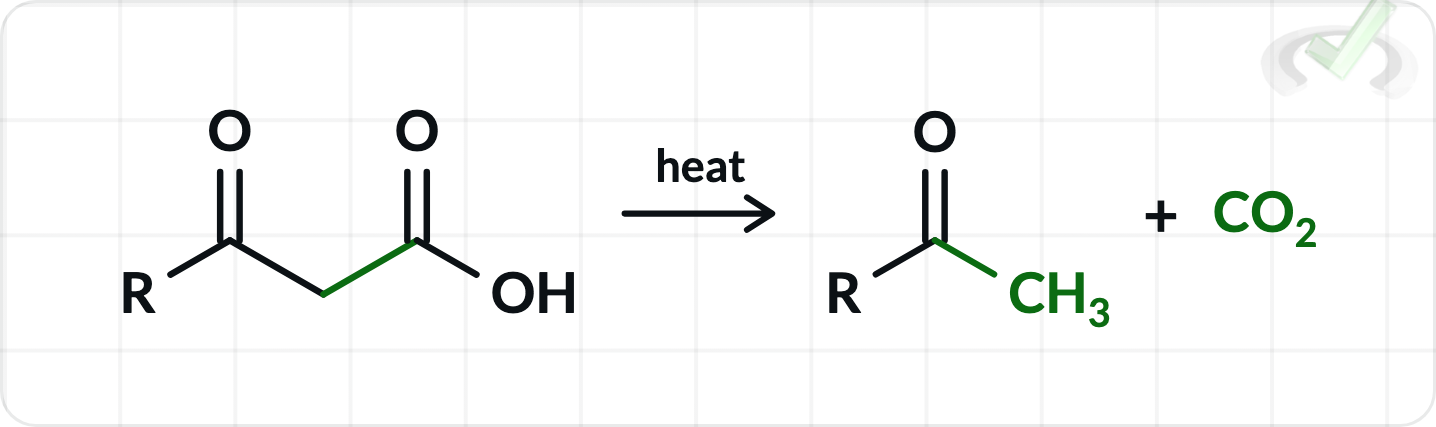
A β-keto acid loses CO2 when heated, through a six-membered ring, and the enol it forms tautomerizes to the keto form. Pyruvate dehydrogenase removes a carbon from pyruvate as CO2. See other reactions of carboxylic acids.
21Substitution at the 2-position
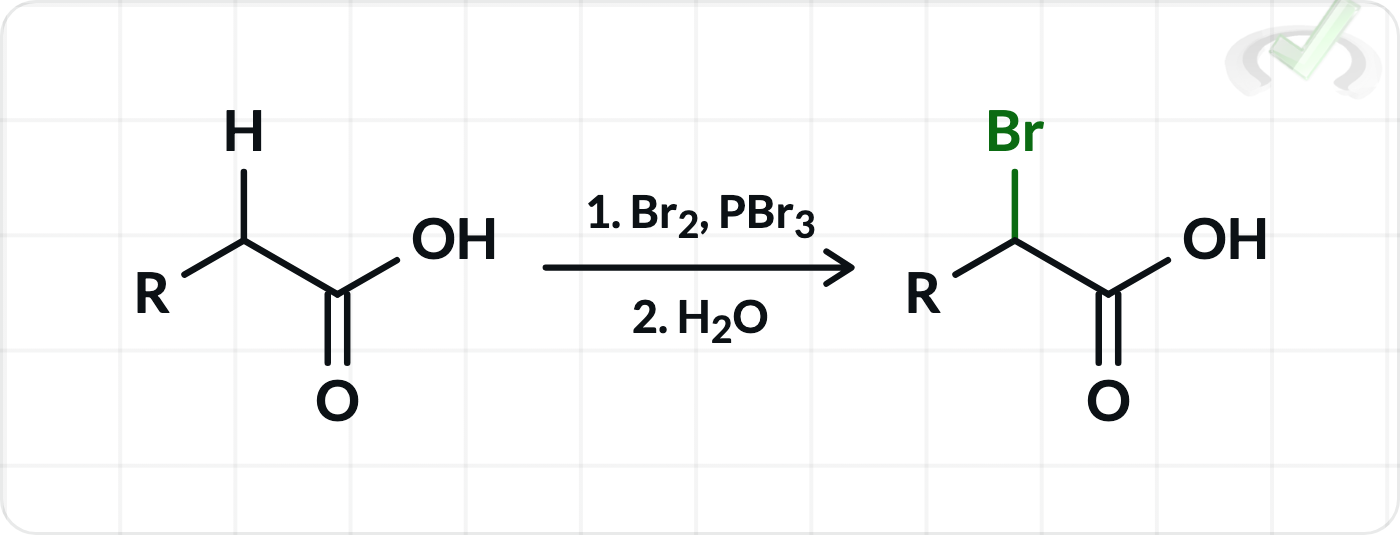
The 2-position is the α-carbon. Br2 and PBr3, then water, put a bromine there through an enol.
A β-keto acid decarboxylates on heating because its second carbonyl lets it form the six-membered ring. A plain carboxylic acid doesn't :)
Free printable PDF
All 31 reactions on pages you can print
You're past the halfway mark! Grab the PDF so you can review these on paper and check a reaction in seconds :)
On its way.
Check your inbox in the next minute.
Acid Derivative Reactions
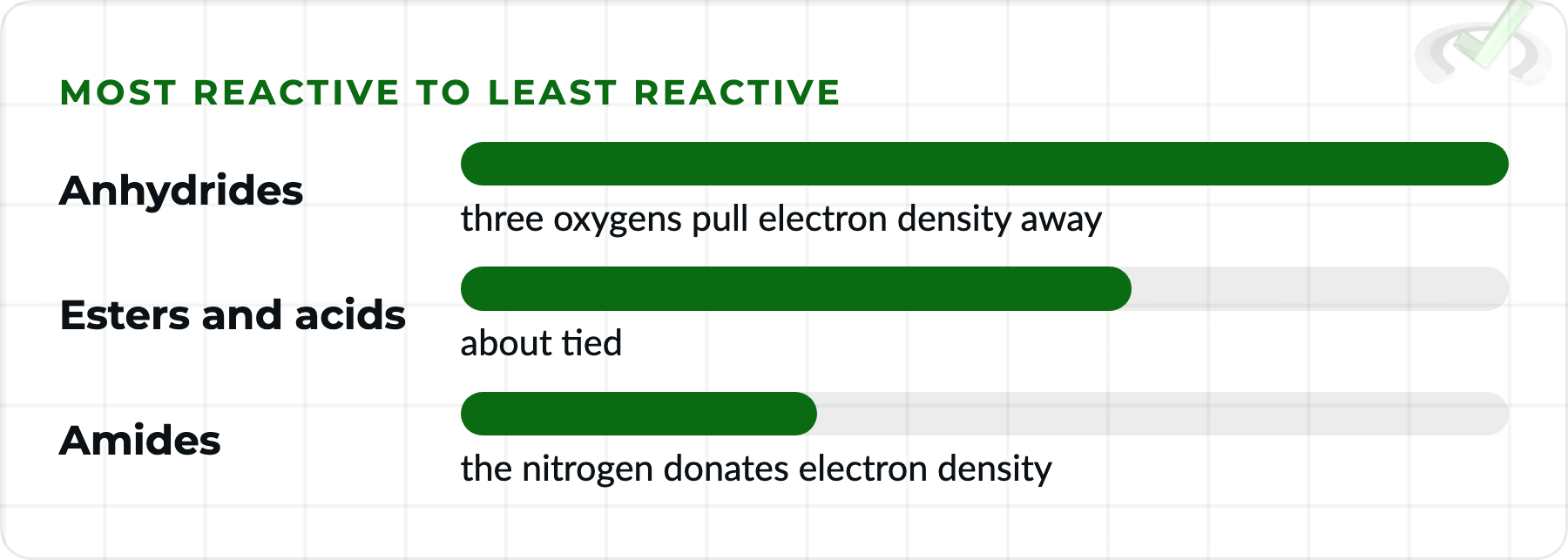
Esters, amides and anhydrides react by nucleophilic acyl substitution, and a more reactive derivative can be turned into a less reactive one.
OpenStax walks through the mechanism if you'd like a second explanation. Of all the MCAT organic chemistry reactions, these four lean hardest on reactivity order!
22Transesterification
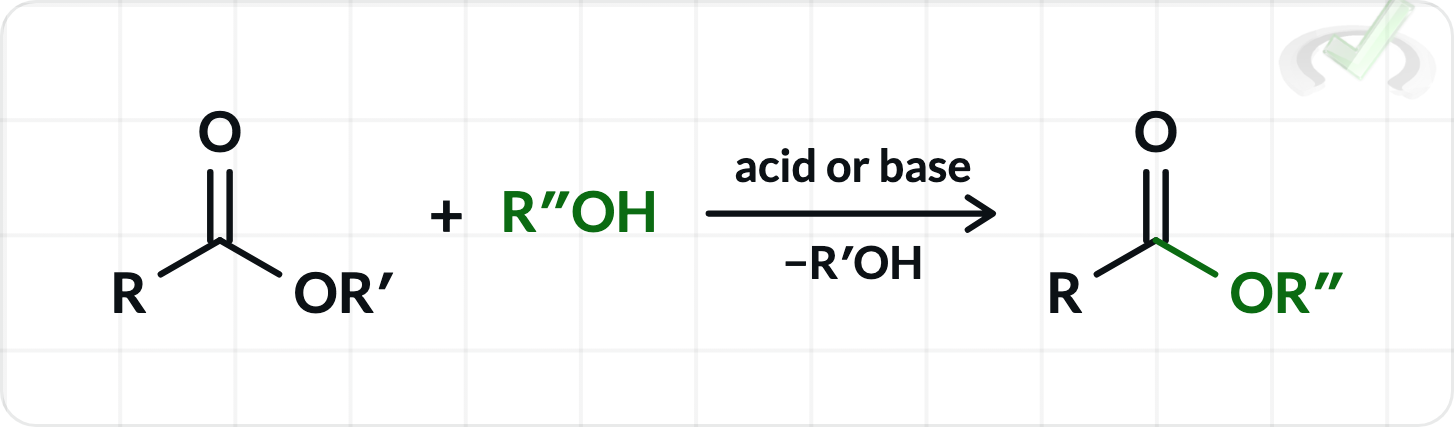
An alcohol swaps out the OR group of an ester, so one ester becomes another, with acid or base. See nucleophilic substitution of acid derivatives.
23Anhydride cleavage
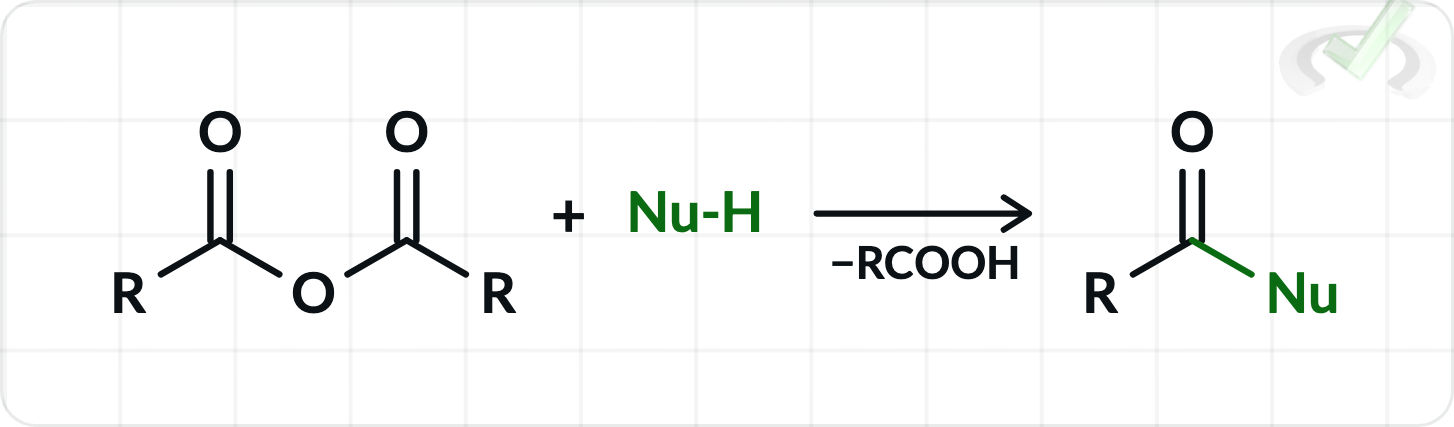
Water gives two acids. An alcohol gives an ester and an acid. Ammonia or an amine gives an amide and an acid.
24Hydrolysis of amides
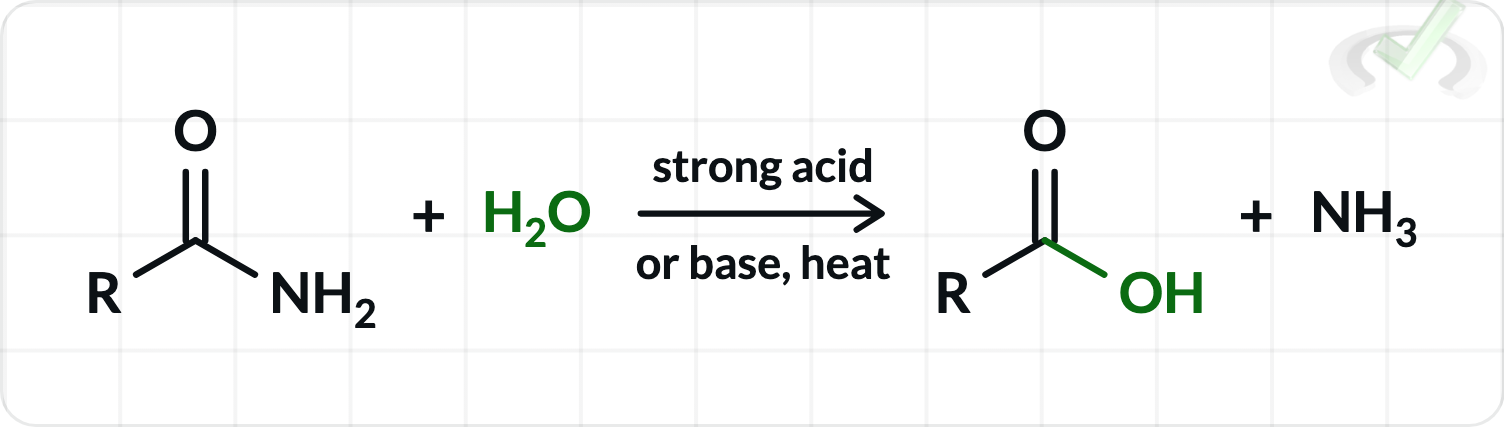
Amides are stable, so breaking one takes strong acid or strong base with heat. In base, the acid ends up as a carboxylate. Proteases do this to peptide bonds under mild conditions.
25Strain in β-lactams
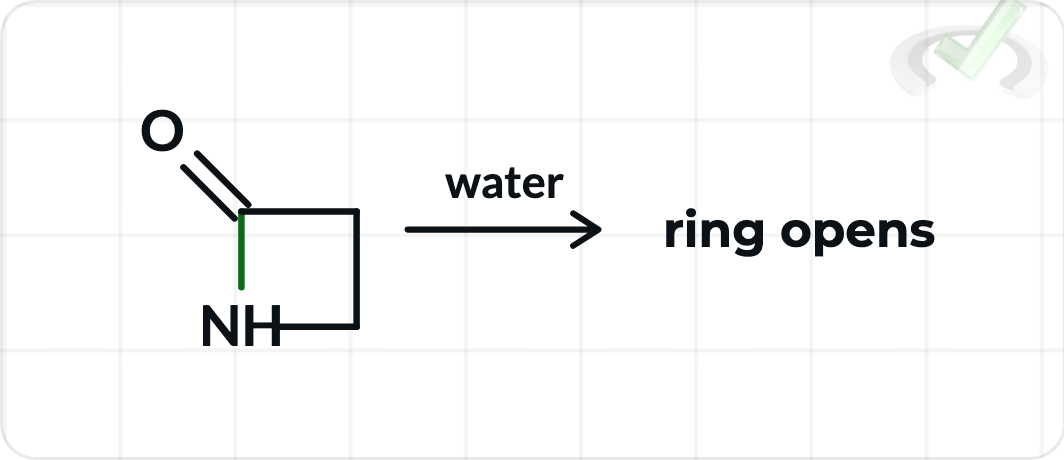
A β-lactam is an amide inside a four-membered ring. Ring angles near 90°, against the 120° the C=O carbon prefers, make it far more reactive than a normal amide. Penicillin carries one!
Anhydrides react fastest, esters and acids sit about level, and amides come last. That single order predicts which direction every conversion on this page can go!
Amino Acid, Lipid and Carbohydrate Reactions
The last six reactions are ones you've already met, now in biological molecules. These MCAT organic chemistry reactions are tested in Bio/Biochem as often as in Chem/Phys!
26Peptide bond
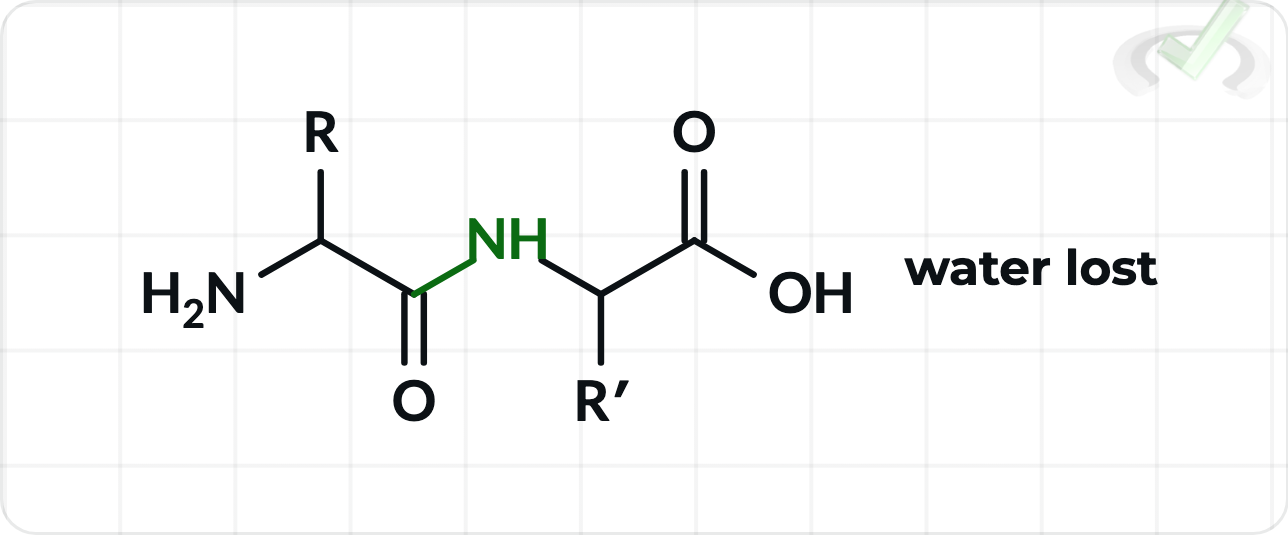
The amine of one amino acid attacks the C=O of another, and water leaves. Resonance gives the C-N bond partial double-bond character, which restricts rotation. See peptide reactions.
27Disulfide bond
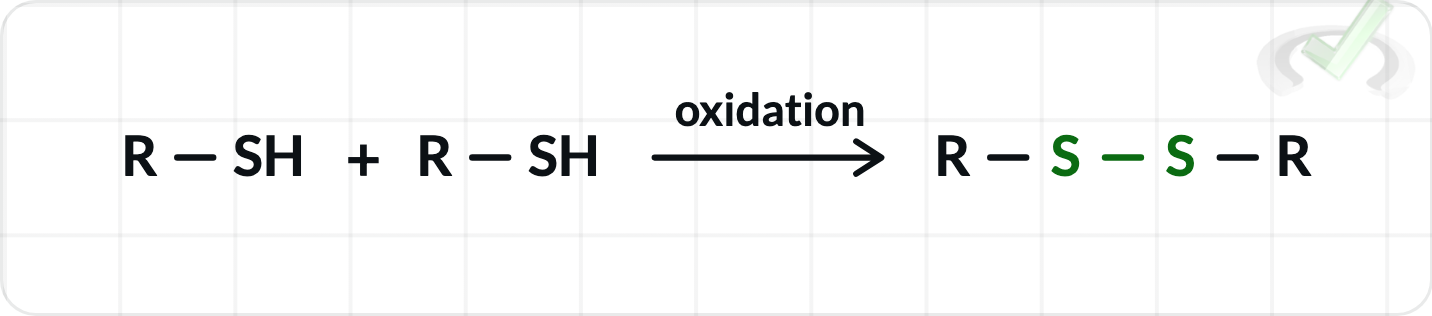
Two cysteines oxidize to cystine, joined by a disulfide (S-S) bond. A reducing agent such as β-mercaptoethanol or DTT breaks it!
28Strecker synthesis
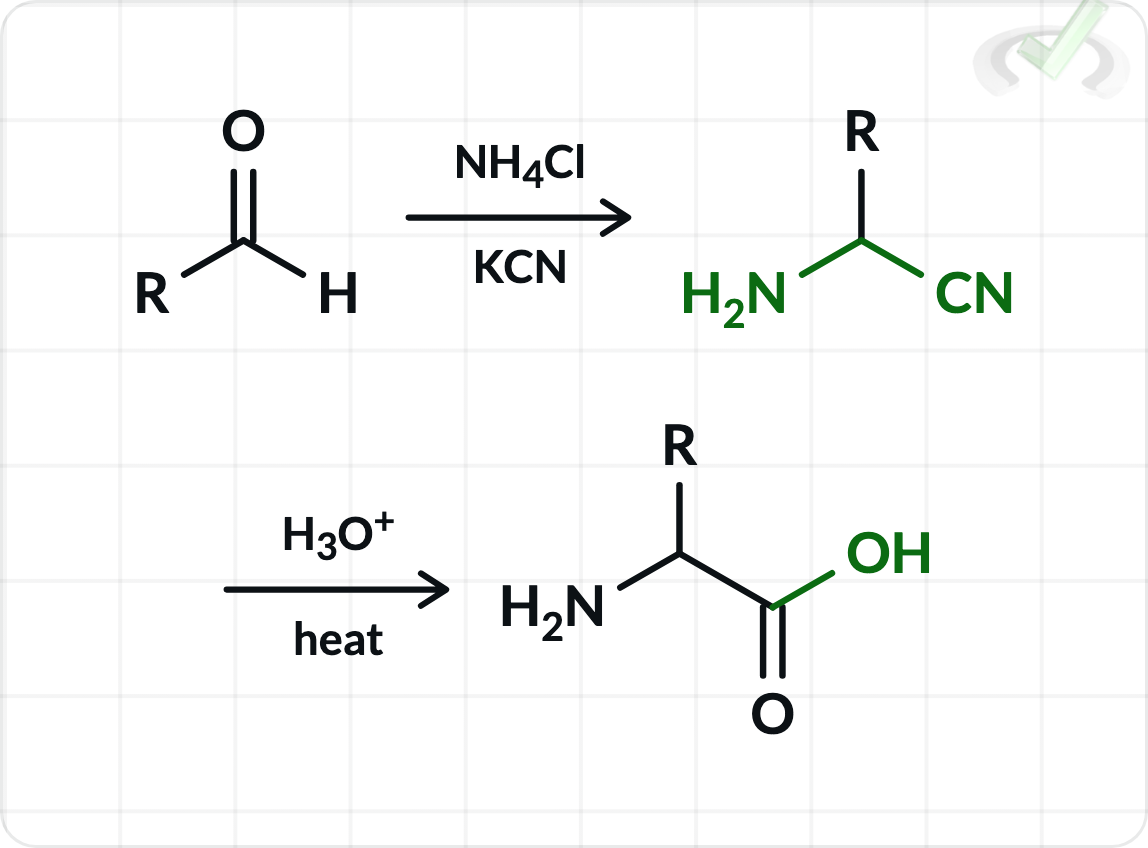
An aldehyde, ammonia and cyanide give an aminonitrile, and acid turns the nitrile into COOH. The flat starting material gives a racemic amino acid. See synthesis of amino acids.
29Gabriel synthesis
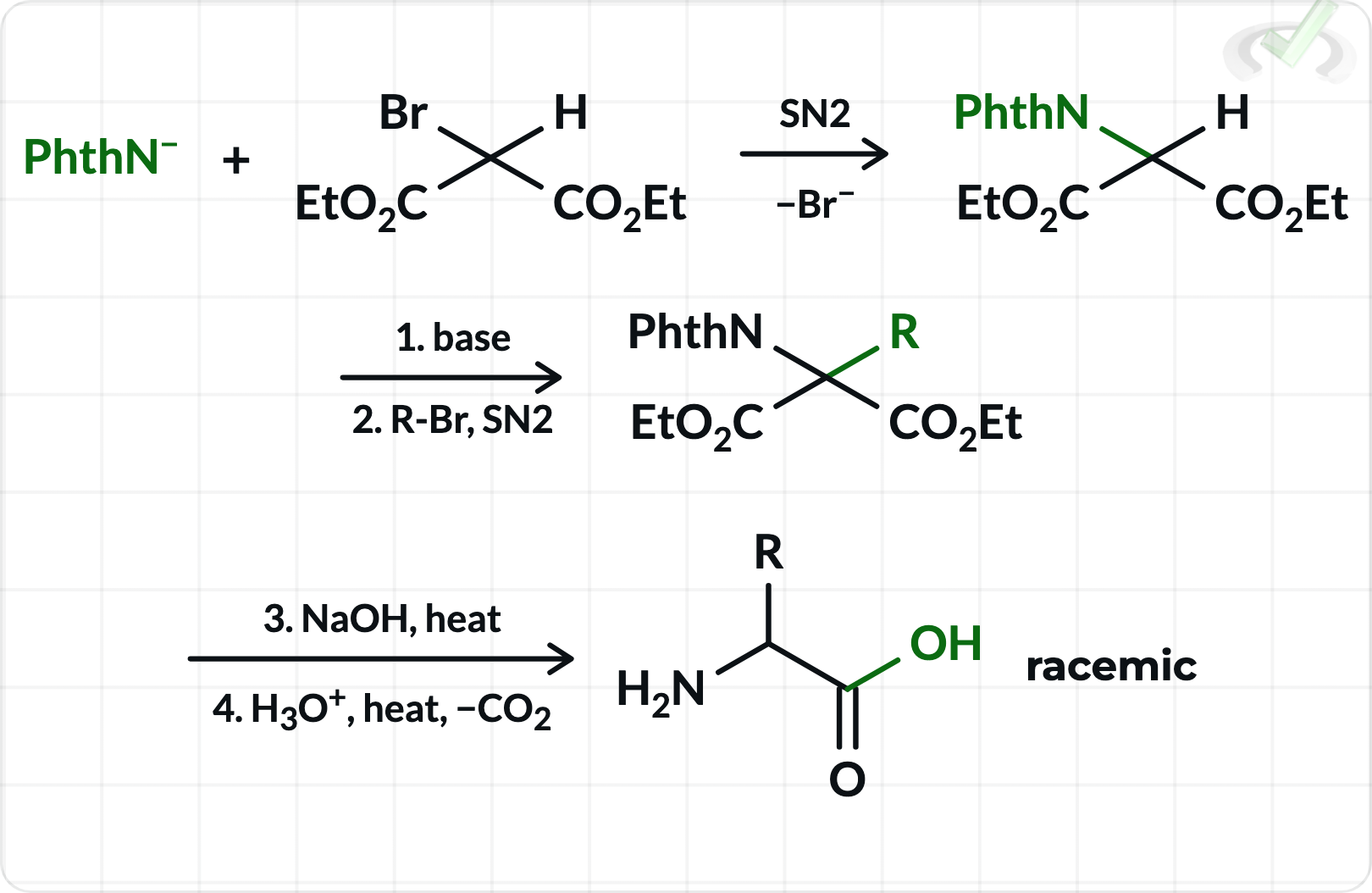
Phthalimide attacks diethyl bromomalonate by SN2, the α-carbon then attacks an alkyl halide by a second SN2, then hydrolysis and decarboxylation free the amino acid. It's racemic too.
30Saponification
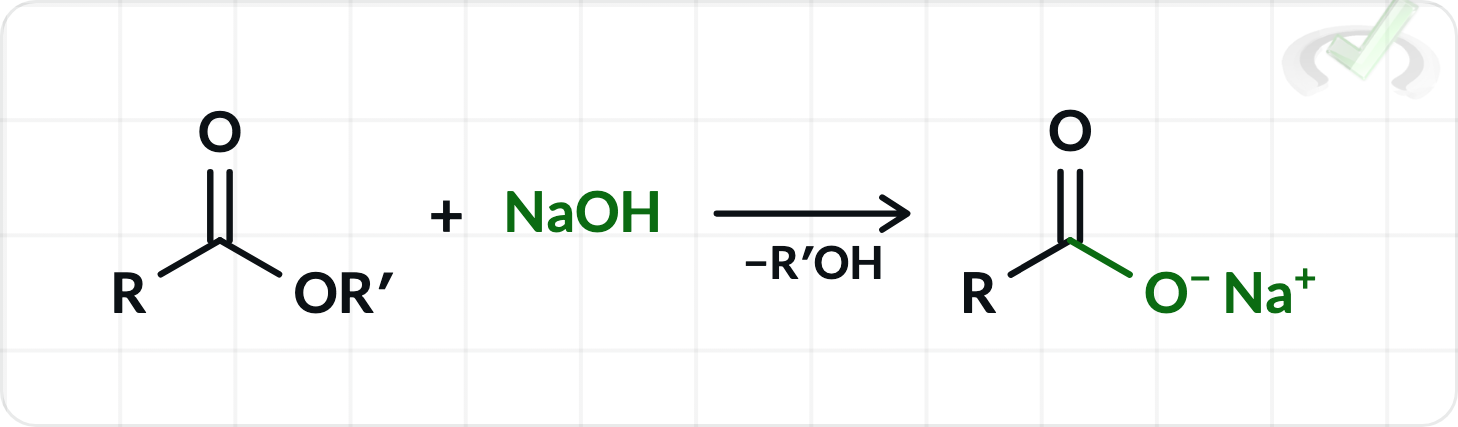
Strong base hydrolyzes the three esters of a triacylglycerol, giving glycerol and three fatty acid salts, which is soap. See types of lipids.
31Hydrolysis of a glycoside
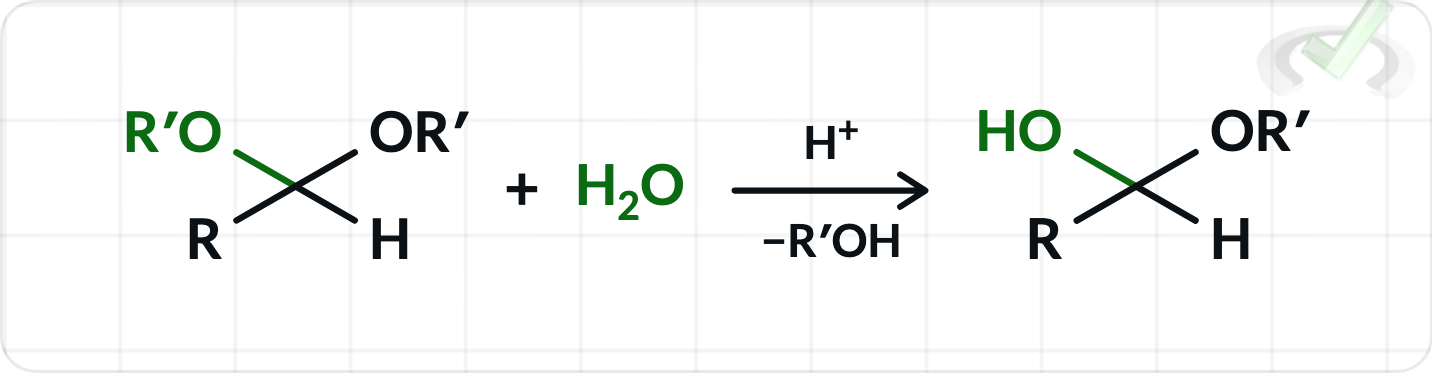
Acid or a glycosidase breaks the bond between two sugars, which reverses acetal formation. Amylase does this to starch. See key carbohydrate reactions.
If you'd like more practice applying these in passages, our Chem/Phys and Bio/Biochem Mastery course has 106 video lessons and 115 AAMC passage walkthroughs from 130+ scorers :)
Free printable PDF
Take the full reaction list with you
Every reaction you just read, drawn the same way, in a PDF you can print and keep handy for practice passages!
On its way.
Check your inbox in the next minute.
Are E1, E2, Grignard and Michael Reactions on the MCAT?
The AAMC outline doesn't name E1, E2, Grignard additions or Michael additions, so they aren't on this list of MCAT organic chemistry reactions. You should still be able to recognize them when a passage uses one.
Elimination competes with substitution. A base removes a hydrogen from the carbon next to the leaving-group carbon, and a C=C forms.
E1 goes through a carbocation like SN1 and is favored by tertiary substrates, weak bases and heat.
E2 happens in one step like SN2 and needs a strong base, and a bulky one pushes toward E2 over SN2. The water loss in an aldol condensation is an elimination too.
Grignard and Michael additions both use a carbon nucleophile, so the three questions above still apply if a passage brings one up!
MCAT Organic Chemistry Reactions FAQs
How many organic chemistry reactions are on the MCAT?
Counted from the AAMC content outline, there are 31 MCAT organic chemistry reactions, from hemiacetal formation to glycoside hydrolysis. The exact number depends on how you group them, but every reaction on the outline is on this page!
Do I need to memorize every mechanism?
Start with the product and the reason the reaction happens, using the three questions above. Mechanism details matter where the outline points at them, like SN1 racemization and SN2 inversion. Learning MCAT organic chemistry reactions product-first keeps the list manageable!
Is there a printable list of MCAT organic chemistry reactions?
Yes! Our free PDF has all 31 drawn out with how to spot each one and what to remember. Grab it from the box at the top or bottom of this page.
How should I study these reactions?
Here's a tip from one of our tutors. Draw each reaction by hand until you can write the product without looking, then practice spotting MCAT organic chemistry reactions in passages. You'll be surprised how fast they start to look familiar!
You've now seen every reaction the AAMC lists for organic chemistry, and most of them come down to the same attack on a C=O. You've got this :)
If you'd like help with orgo passages, the 6-Week Live MCAT Accelerator is where we'd start. If the cohort dates don't line up, 1:1 tutoring with a 515+ scorer fits around your schedule!
Free printable PDF
Keep all 31 reactions beside you for a 130+ in Chem/Phys
Print it once and you'll have every reaction on the AAMC outline within reach while you study :)
On its way.
Check your inbox in the next minute.
Back to Organic Chemistry on the MCAT


 To help you achieve your goal MCAT score, we take turns hosting these