

Two patients receive the same diagnosis and the same treatment plan. One finishes the course of care and recovers. The other misses three appointments, cannot afford the prescription, and returns to the emergency department six months later. Nothing about their biology explains the difference. Everything about their circumstances does. Let’s explore how health and healthcare disparities are tested on the MCAT.
I. Introduction to Health and Healthcare Disparities
Health outcomes are not distributed evenly across a population, and the reasons are mostly social rather than biological. The MCAT tests whether you can identify those reasons inside a passage and name them correctly.
Three definitions do most of the work on test day.
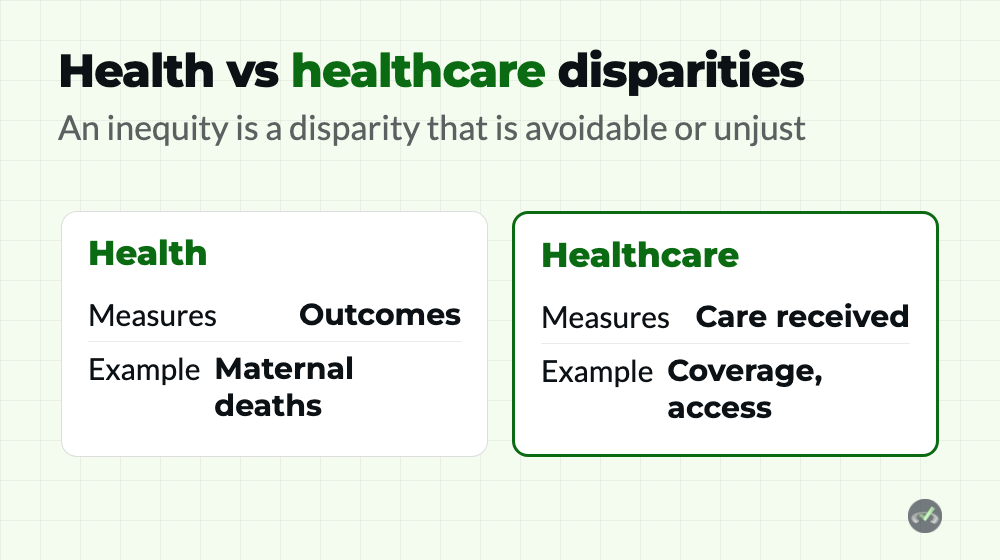
A health disparity is a difference in health outcomes between groups. Maternal mortality is higher among Black women in the United States than among white women. That difference is a disparity. It is measurable, and it describes an outcome.
A health inequity is a disparity that is avoidable, unjust, or unfair. Every inequity is a disparity, though not every disparity is an inequity. Older adults have more cardiac events than twenty-year-olds, which is a difference without being unjust. When a difference traces back to a policy or structure that could have been built differently, it becomes an inequity.
A healthcare disparity is narrower. It refers to differences in the care people receive, such as access to a provider, quality of treatment and insurance coverage. Health disparities describe outcomes. Healthcare disparities describe the system producing them.
Key Concepts
- Health disparity, health inequity, healthcare disparity
- Social determinants of health and structural determinants of health
- Socioeconomic status, cultural capital, social capital
- Environmental racism and environmental justice
- Access, quality of care, and insurance status as separate barriers

Free cheat sheet
The Social Institutions Cheat Sheet
Family, education, religion, government and medicine, and what each one does for social structure. Four pages.
On its way.
Check your inbox in the next minute.
II. Social and Structural Determinants of Health
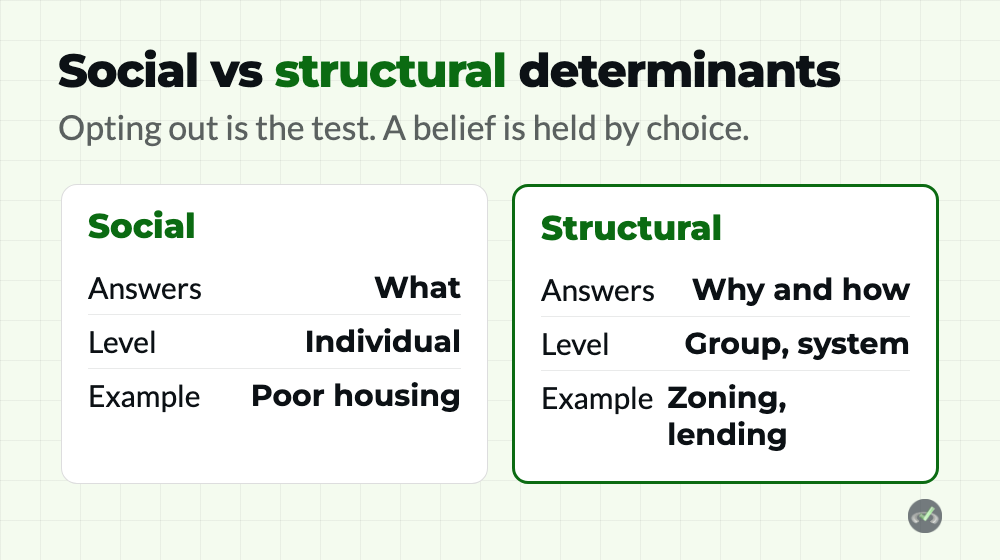
Social determinants of health are the conditions in which people are born, grow, live, work, and age. They operate at the level of the individual and the immediate community. Examples include education level, socioeconomic status, housing quality, access to nutritious food, exposure to violence, and the strength of someone’s social support.
These conditions translate into biology. Unstable housing raises chronic stress, and chronic stress contributes to hypertension and cardiovascular disease. A building containing asbestos raises lung cancer risk. Living in a food desert, an area without reasonable access to fresh food, shapes diet, and diet shapes the risk of type 2 diabetes.
Structural determinants of health are the upstream, system-level forces that create and maintain those conditions. They operate at the level of the group, through laws, policies, institutions, and power structures. Healthcare policy, institutionalized racism, redlining, zoning ordinances, and incarceration policy all belong here.
Telling them apart
One heuristic resolves most discrete questions on this material:
Social determinants answer what. Structural determinants answer why and how.
Someone lives in low-quality housing. The housing itself is the social determinant. The zoning ordinance and lending practice that concentrated low-quality housing in that neighborhood are the structural determinants.
A community’s shared belief about preventive medicine sounds structural, because a community is a group. It is still social. Structural determinants are the ones an individual cannot opt out of. A religious belief about medicine is held by choice. A zoning policy forbidding a clinic is not.
Related concepts that share this territory
Socioeconomic status (SES) combines economic class and social standing. It predicts access to healthcare, nutrition, and education, along with exposure to occupational and environmental hazards, which is why it appears as a variable in so many Psych/Soc passages.
Cultural capital is the non-financial advantage carried by education, speech, manner, and presentation. Social capital is the advantage carried by networks and connections. An applicant admitted partly because a relative attended the same university is drawing on social capital. Neither is money, and both open doors.
Environmental racism describes the disproportionate exposure of minority communities to pollutants and environmental hazards. Environmental justice is the movement responding to it.
III. Where Healthcare Disparities Show Up
Position on the socioeconomic ladder predicts access to education, housing, and healthcare together, and the three reinforce one another. Higher SES tends to mean better schooling, which tends to mean higher-wage work, which tends to mean better housing and better care. The same chain runs in reverse going down.
At the lower end the health consequences cluster together. They include higher disease burden, less access to treatment, substandard housing with indoor environmental exposures, diets weighted toward inexpensive processed food because fresh produce costs more, and physically punishing work in jobs that do not require a degree.
The MCAT also expects you to recognize disparities that follow group membership rather than income.
Race and ethnicity
Black and Hispanic patients have worse access to high-quality care. Two mechanisms operate at once. One is access itself, and the other is the quality of care delivered once access happens. Documented discrimination within healthcare systems produces well-founded mistrust, and mistrust reduces the use of preventive care, which worsens outcomes later.
Gender and gender identity
Women have historically been underrepresented in clinical research, and pregnant people are excluded from many trials outright. Thinner evidence means fewer approved treatments and more uncertainty in prescribing. Transgender patients report discrimination from providers, and a bad experience reliably reduces future care-seeking.
Geography, disability, and insurance
Rural patients may have no nearby primary care provider and may drive hours to the closest hospital capable of a given procedure. For patients with disabilities, physically reaching an appointment can itself be the barrier. Being uninsured or underinsured limits care directly, and high out-of-pocket cost causes some patients to avoid care altogether.
IV. Policy Responses and Their Limits
Three programs come up often enough to know by name.
The Affordable Care Act (ACA) aimed to close coverage gaps and expand access.
Medicare covers adults aged 65 and older, along with some younger people who have qualifying disabilities.
Medicaid is means-tested, so eligibility depends on income falling below a threshold.
The MCAT-relevant point is not the legislative detail. It is that these programs narrowed the gaps without closing them. Not everyone qualifies, and coverage alone does not make care financially manageable, nearby, or culturally competent.
V. Bridge/Overlap
Structural functionalism
Institutions persist because they serve functions within a society. Applied here, this explains how an institution can go on reproducing an inequality while operating as designed.
Conflict theory
Society is framed as competition over scarce resources. Healthcare access is a resource, so this maps onto the material directly. A higher-status group secures more of it, and a lower-status group secures less.
Intersectionality
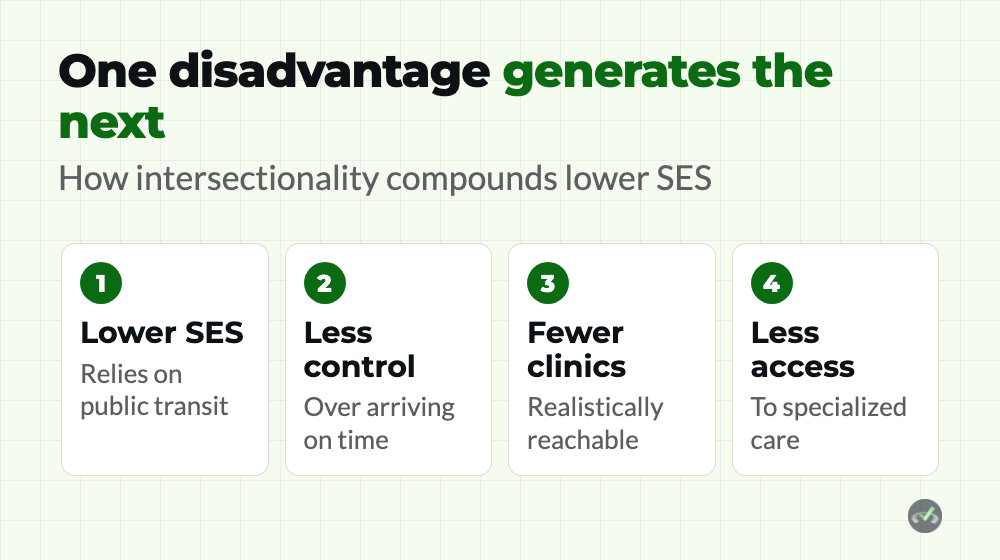
Disadvantages overlap and compound rather than adding together. Lower SES may mean reliance on public transit, which means less control over arriving on time, which limits which clinics are realistically reachable, which restricts access to specialized care. One disadvantage generates the next.
Social stratification and mobility
These supply the ladder the whole topic sits on. See Social Structure and Stratification for the framework, and Social Institutions for how healthcare functions as an institution.
VI. Wrap-Up and Key Terms
Social determinants are individual-level conditions, such as housing, food access, education and social support. Structural determinants are the policies and systems producing those conditions. Social determinants are the what; structural determinants are the why and the how.
You are unlikely to be asked outright which item is a social determinant. The exam assumes that and tests whether you can spot the mechanism inside a passage, usually in one of three forms:
- A chart of differing outcomes between groups, where you identify the determinant behind the difference.
- A vignette about unequal access, where the reason matters, whether that is transportation, work schedule, family support or insurance.
- A confounding variable, where socioeconomic status explains a relationship the researchers attributed to something else.
Key Terms
VII. Practice Questions
Sample Practice Question 1
Which of the following is most accurately classified as a structural determinant of health?
- A. A patient’s level of health literacy
- B. A community’s cultural beliefs about preventive medicine
- C. A zoning policy that limits where clinics can be built
- D. Family support during a hospitalization
Answer: C. A zoning policy is a system-level rule an individual cannot opt out of, and it explains why healthcare access is limited in a given area.
Choice A is individual, so it is social. Choice B is the trap. Community sounds group-level, but shared beliefs are held by choice and remain social. Choice D is a textbook social determinant.
Sample Practice Question 2
A public health team studies transportation access and diabetes management across three low-income urban neighborhoods. All three are food deserts with limited public transit. Neighborhood A receives a subsidized shuttle to a grocery store and a community health center. Neighborhood B receives expanded telehealth with no transportation change. Neighborhood C receives no intervention. After six months, Neighborhood A shows the largest improvement in A1C and clinic attendance, and its patients also report fewer missed work days.
Which of the following best explains Neighborhood A’s outcome?
- A. Residents gained social capital through the shuttle program
- B. Transportation barriers were addressed, reducing a structural determinant of health
- C. Residents received formal education in diabetes management
- D. The food environment in the neighborhood was directly improved
Answer: B. The only intervention in Neighborhood A was transportation, so the explanation has to concern transportation.
Choice A misapplies the term, since social capital means networks and connections and the passage describes neither. Choice C asserts an intervention the passage never mentions. Choice D fails on the word directly, since no grocery store was added, only a shuttle to an existing one.
VIII. Supplemental Resources
Want to go deeper on this topic? Here’s where to read, watch and practice it next.
Read
- Kaplan MCAT Behavioral Sciences Review 2026-2027, §12.2 and §12.1
- The Princeton Review MCAT Psychology and Sociology Review, sections 8.2 through 8.3
Watch

- “Health and healthcare disparities in the US” (Khan Academy)
Practice passages
- “Disparities in healthcare access” (2 of its 5 questions test this topic)
Official AAMC practice that tests this topic
- Psych/Soc Section Bank, Passage 6, Q42
Get the Social Institutions cheat sheet
On its way.
Check your inbox in the next minute.





 To help you achieve your goal MCAT score, we take turns hosting these